Category: Film Analysis

  • Donnie Darko Ending Explained: Why Donnie Laughs, Who Frank Is, and What the Film Is Really About

    Donnie Darko Ending Explained: Why Donnie Laughs, Who Frank Is, and What the Film Is Really About

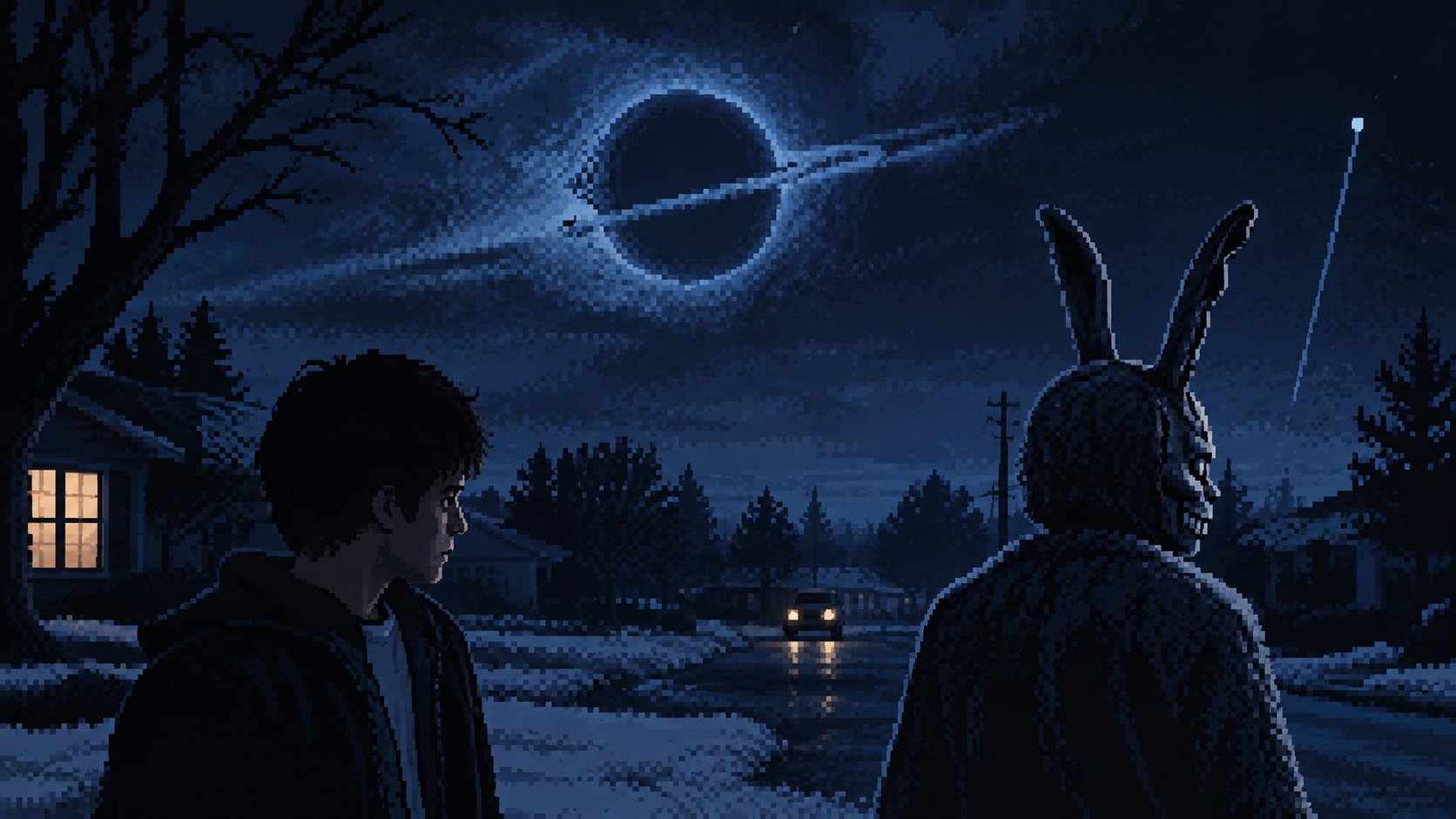
    Pixel art inspired by “Donnie Darko” (2001)

    The Donnie Darko ending explained simply: Donnie lets the jet engine fall on him, closing the broken “tangent universe” and saving the people he loves. He laughs because his deepest fear, dying alone and for nothing, turns out to be false. His death is chosen, it has a meaning, and it ties him to others instead of cutting him off from them.

    I want to separate the mechanics of the plot (the engine, the loop, the rules of the book) from the meaning of the film, check both against the film’s own rules and against what Richard Kelly, who wrote and directed the film, has said about the force guiding Donnie, and bring the whole thing down to one idea. Kelly built a clockwork machine so that a teenage boy could make one decision, and that decision is the film. I read it as a stoic film: accept what you cannot change, act on what you can, and the boy in the bed learns to do both.

    Donnie Darko ending explained: what happens at the end?

    Time rewinds to the night of October 2, 1988, the jet engine crashes through the roof again, and this time Donnie stays in bed. He dies, the tangent universe collapses, and everyone he saved wakes up in a world where the last 28 days never happened.

    At the start, a figure in a rabbit suit lures our sleepwalking hero out of the house just before a jet engine falls into his bedroom. Everything that follows happens in a world that should not exist, because the boy was supposed to die in that bed. By the final night, that world has gone wrong in every direction. The girl he loves lies dead on the road. He has shot the young man who killed her. His mother and little sister are on a plane about to tear apart in the sky. He sends the engine back, the film rewinds, and we see him in his bed, awake, waiting.

    Why does Donnie laugh before he dies?

    This is the moment I care about most. One common reading, which Looper sets out, is that he laughs because he has carried out the plan: he has saved the universe and, with it, Gretchen and Frank.[1] Kelly’s own commentary frames the force guiding him as something close to God, fate or destiny.[1] I do not read it as “it was all a dream” or “he was crazy all along.” He remembers, or understands at some level below memory, what the other version of events cost. If he runs from the engine again, the girl dies, the young man in the rabbit suit dies, his mother and sister are put in mortal danger, and the whole world may stop existing. So he stays.

    He laughs out of relief and out of the sheer paradox of it. For the entire film this boy has been terrified of dying alone. Now he chooses to die alone, in his own bed, and that exact death is what connects him to everyone else and saves them. It is a moment of enlightenment: for the first time, he knows precisely what to do.

    So who dies? In the final, “real” timeline, only Donnie. Every other death happened in a world that has been erased.

    What is the tangent universe, and what caused it?

    The tangent universe is an unstable copy of reality that splits off when the engine appears without a cause. It can only last 28 days, and if it is not closed it collapses and takes the primary universe with it.

    Inside the fiction, the rules come from a book called The Philosophy of Time Travel, written by the old woman the town calls Grandma Death. The book (excerpts of which Kelly added to the director’s cut)[2] gives us the vocabulary: the Primary Universe, the Tangent Universe, an “Artifact” that appears in it (the engine), and a “Living Receiver” chosen to send that Artifact back before the tangent collapses. Around him, the “Manipulated Living” and the “Manipulated Dead” quietly push him toward his task.

    What caused it? The film never gives a tidy origin, and I think that is deliberate. Dramatically, the tangent universe is a world that exists because Donnie escaped his death. In a sense, his survival is the tangent universe: every day he lives past October 2 is borrowed time.

    Where did the jet engine come from?

    The engine comes from the future. It falls off the airliner carrying Donnie’s mother and sister home from Los Angeles on the last night of the tangent universe, and Donnie sends it back through the vortex so it lands in his bedroom 28 days earlier.

    The engine that nearly kills him at the start is the one that comes loose at the end. Nobody can find which plane it belongs to, because the plane has not lost it yet. On the ridge, Donnie is the “Living Receiver” closing the circuit: the engine goes back, the tangent universe closes, and the only cost is the life he should never have kept. As a storyteller I love that Kelly takes the biggest possible event and aims it at the smallest possible room: a teenager’s bed.

    Who is Frank, and why is Frank a bunny?

    Frank is the young man in the rabbit costume, the boyfriend of Donnie’s older sister, who later runs over the girl Donnie loves and is shot by him. The Frank who visits Donnie is a version of that young man after his death, a messenger returning from the future to steer the past.

    He is, at the same time:

    • a messenger of death,
    • the boy’s guide through the 28 days,
    • the man the boy will kill,
    • and a consequence from the future that comes back to change its own past.

    The simplest way I can put it: Frank is death, who first saves Donnie so that Donnie can understand why he should die. Notice the wound. The visitor in the mask has a ruined eye. On the last night, the young man in the costume takes off his mask, and the boy shoots him through that eye. The ghost carries the injury before it happens.

    And the rabbit? Watership Down by Richard Adams is a clear thematic companion to the character, and the book is woven into the film (in the director’s cut the English teacher assigns it in place of the Graham Greene story and the class discusses it[3]; it is the novel of Fiver, the small rabbit whose apocalyptic visions save his warren). It is a story about a community under threat, about sacrifice, and about the search for a safe place. The rabbit is not a random horror mask. It is the film’s theme wearing a costume.

    Is Donnie schizophrenic, or is the time travel real?

    The film’s own rules suggest that the science fiction is real inside its world, which resists the reading that everything is just Donnie’s schizophrenia. But the film is built so that both readings stay available, and that ambiguity is part of the point.

    Donnie sees a therapist, takes medication, and hallucinates a six-foot rabbit, so you can watch the whole film as a portrait of illness. The film pushes back: its science fiction world has real rules. Here is what matters to me. The tangent universe, the engine and Frank are neither only metaphors nor only gadgets. The fantastic construction exists so that the boy can see the consequences of his continued life and then make the decision again. The sci-fi machinery gives a physical form to his inner question: is it better to survive and cause other people’s suffering, or to die so that others can live?

    Destiny or free will: what is the point of Donnie Darko?

    The film never fully settles it. Donnie is guided, almost pushed, by Frank and by the people around him, but he performs the one act that matters himself: this time, he does not leave the room.

    You can read him as a tool of destiny. The rabbit leads him step by step, and the people around him are placed like pieces on a board. And yet the decisive action is his. This is where the apparent opposites make peace: we do not choose all the circumstances of our lives, but we can choose how we answer them. He does not choose the falling engine. He chooses to stay underneath it.

    For me, this is the most important thing in the film, and it is why I think of Donnie Darko as a deeply stoic film. Stoicism is not indifference to your fate. It means responding with dignity to the things you can influence and changing them according to your ethics, and on the other side, accepting what you cannot change, whatever fate hands you. The boy does both. He accepts the engine. And he acts on what he can change: his own survival, which is what leads to all the other tragedies.

    Love or fear: why does the “Lifeline” lesson matter?

    The gym teacher makes her students sort every human action into two boxes: love or fear. He rebels, because life is far more complicated than that. The film deliberately shows this system as a crude reduction of reality.

    The ending, though, turns back to that split in a sly way. At the start, the boy acts mostly out of fear: of loneliness, of death, of meaninglessness, of losing control. At the end, he performs an act of love. So the gym teacher is right on the most basic level, and completely wrong about the price. Love is not a slogan from a self-help video. It can mean consciously accepting suffering and death.

    Why does Gretchen wave at the end?

    Because something of the erased world survives in the people who lived through it. Gretchen does not remember Donnie, yet she waves to his grieving mother as if she knows her, and the mother waves back.

    Set to “Mad World”, the final montage shows the town waking after the rewind. Nobody consciously remembers the 28 days, but something stays. The young man who wore the rabbit suit touches his eye. The motivational speaker wakes up weeping. Others wake with guilt, sadness, unease. And the girl the boy loved, riding past the house the morning after his death, waves to a woman she has never met.

    My reading: our bonds, and the moral consequences of what we do, live deeper than conscious memory. Donnie dies physically alone, yet the people he saved carry a trace of his sacrifice inside them. That wave is the proof that he was right to stop being afraid.

    Why was the teacher fired, and what is the film’s second layer?

    The English teacher is fired after the gym teacher, a devotee of the self-help guru, blames the school’s flooding on Graham Greene’s story “The Destructors”, which she had assigned, and rallies the parents against her. Her firing belongs to the film’s second layer: a smart teenager seeing through the falseness of the adult world.

    It is also a film about a gifted kid among adults who cannot answer the real questions:

    • the school replaces thinking with slogans,
    • the authorities turn out to be hypocrites (the man selling love and fear is hiding something monstrous in his house),
    • the adults have no answers to the questions that actually matter,
    • and society labels the inconvenient boy as sick, even though he sees its dishonesty more clearly than anyone.

    Donnie confronts a system of conformity while trying to understand his community. Underneath is a timeless conflict between generations: the young face problems their elders do not understand.

    What is Donnie Darko really about?

    It is about making peace with death by discovering that we are bound to other people.

    Donnie “saves the world”, yes, but that is the surface. At the beginning he is afraid he will die alone. At the end he understands that a person may die alone, but does not have to die without love, without meaning, without connection to others. That is why he laughs. He has found out that his greatest fear was false. It is the stoic lesson I mentioned at the start, lived rather than preached: he cannot change the engine, so he accepts it, and he can change what his survival does to others, so he acts.

    Still, there is no single, mathematically closed answer here. The viewer’s disorientation and the open questions feel intended, and the film reveals new layers on repeat viewings. The uncertainty is part of the meaning: like the boy in the bed, we are never handed a complete instruction manual, and still we have to decide what we will give meaning to.

    So if I had to say what the film is about in a single breath, here is my reading. For me this is, at its core, a stoic film, and the governing idea it steers by is this:

    Life is a chaos no one controls, and what remains ours is the response: to meet what we cannot change with dignity, and to build our lives around the good of others instead of around our own fear.

    Nobody in the film ever says this out loud. It is carried by the rabbit, the countdown, the wound in Frank’s eye, the waving hand on the morning after, and above all by the arc of a boy who goes from running away from the engine to waiting for it.

    And if I imagine the short line Kelly might have kept in his head on set, the beacon that keeps every scene, every song and every cut pointing at that bed, my guess is it would be this:

    You do not choose your fate, only how you meet it.

    How Richard Kelly makes you feel it before you understand it

    What strikes me most, as a filmmaker, is the delivery. The philosophical core is hidden and, at its depth, very simple, and Kelly tells it as a coming-of-age movie. I do not know another film that joins coming-of-age and science fiction this well, stays this philosophically rich, and keeps its science fiction from ever feeling silly. That balance is why people still argue about it twenty-five years later.

    The trick is that the film works emotionally before it works logically. Kelly hides a rigid sci-fi mechanism under a teen-movie surface, so you follow the boy, the girl and the school, and only later realize every scene was a gear in a clock.

    A few of his tools:

    • Needle-drops. The 1980s songs make the town feel lived-in and ordinary, so the impossible things land harder against them.
    • The slow-motion Steadicam through the school. The gliding introduction to the corridors, cut to a pop song, presents the whole social world in one breath. It feels like a music video, and that is the point: it is the teen-movie surface, and it seduces us before the machine starts turning.
    • A score that carries the dread. Under the jokes, the music keeps a low, melancholy pulse, so you feel the countdown in your body even in trivial scenes.
    • The countdown as structure. Title cards counting down the days turn a loose teenage story into a clock. Give the audience a deadline and every ordinary scene gains tension.
    • Restraint with the fantastic. The rabbit, the water “spears” and the vortex are staged plainly and never over-explained, so they read as part of this world rather than as effects.

    The final rewind is the clearest example: the film reverses its whole plot and gives us not an explanation but a face, a boy in bed, laughing.

    If you want to learn to hide a meaning inside structure so the audience feels it long before they can explain it, that is exactly what I teach in Understanding Films: Decode the Invisible Meaning.

    Quick answers

    What is the song at the end of Donnie Darko?

    It is “Mad World”, the Tears for Fears song, in a slow cover by Gary Jules with Michael Andrews.[4] It plays over the final montage of the town waking up.

    Should I watch the theatrical cut or the director’s cut?

    Watch the theatrical cut first; it keeps more mystery. The director’s cut puts pages of The Philosophy of Time Travel on screen and spells out the rules, which is great on a rewatch but explains too much the first time.

    Who plays Frank in Donnie Darko?

    Frank is played by James Duval.[4] The rabbit suit is his Halloween costume.

    Is there a Donnie Darko 2?

    There is a sequel, S. Darko (2009), following Donnie’s younger sister, but Richard Kelly was not involved in it.[5]

    Sources

    1. Donnie Darko’s Ending Explained — Looper ↩
    2. How Donnie Darko: The Director’s Cut Changes The Movie — /Film ↩
    3. What’s the Difference Between the Donnie Darko Theatrical and Director’s Cut? — SYFY WIRE ↩
    4. Donnie Darko (2001) Full Cast & Crew — IMDb ↩
    5. ‘Donnie Darko’ director says 2009 sequel was “horribly violating” — NME ↩
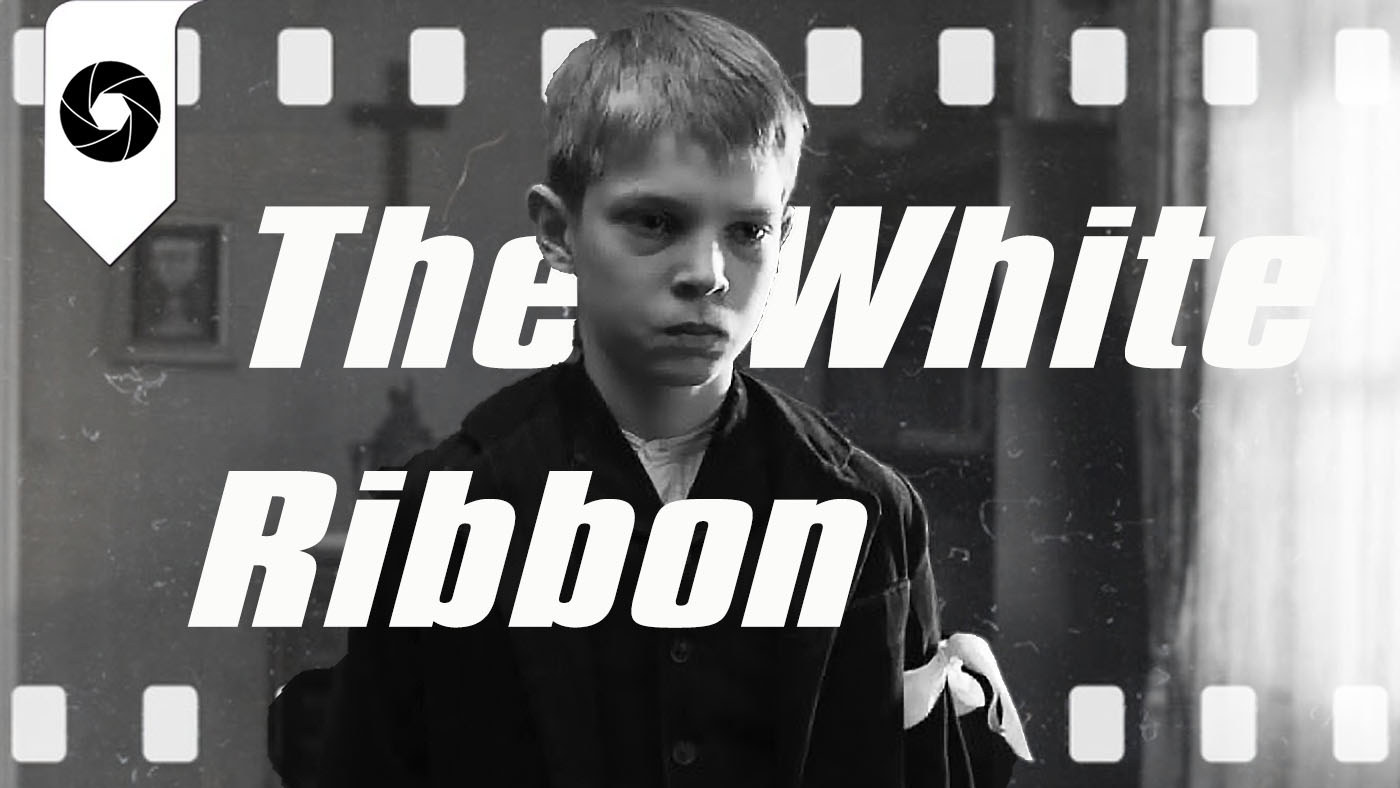
  • The White Ribbon: Decoding the Symbolism of Evil’s Birth

    The White Ribbon: Decoding the Symbolism of Evil’s Birth

    Michael Haneke’s acclaimed film “The White Ribbon” (2009) presents viewers with a chilling portrait of a German village just before World War I. Shot in stark black and white, the film chronicles a series of mysterious violent incidents in the fictional village of Eichwald.

    Beyond its surface narrative, Haneke’s masterpiece contains rich symbolism that speaks to the origins of fascism, the cycle of violence, and the corruption of innocence. The White Ribbon symbolism plays a crucial role in understanding the film’s deeper themes. Let’s explore the deeper meanings behind this disturbing yet profound examination of human nature, focusing on how The White Ribbon symbolism serves as a lens through which we can interpret the psychological foundations of authoritarian ideology.

    The Setting: A Society on the Brink

    Set in 1913-1914, the timing of “The White Ribbon” is deliberate and significant. Haneke specifically chose the period before World War I to examine the social conditions that would eventually lead to the rise of Nazism decades later. The film depicts a rigid Protestant community governed by strict religious principles and unquestioned patriarchal authority.

    This particular village becomes a microcosm of German society, revealing the hidden tensions, hypocrisies, and structural violence that would later explode on a national scale. The seemingly idyllic rural setting masks a community riddled with cruelty, abuse, and suppressed rage—all waiting to erupt like a “ticking bomb,” as Haneke himself has described it.

    The Symbolism of the White Ribbon

    The film’s title refers to the white ribbons that the village pastor forces his children to wear as a reminder of their supposed innocence and purity. This potent symbol operates on multiple levels:

    1. Supposed Purity: Ostensibly, the white ribbon represents innocence and moral purity—virtues the children should aspire to maintain.

    2. Symbol of Control: More sinisterly, the ribbons function as visible markers of the pastor’s control over his children—a constant reminder that they are being monitored and must adhere to his strict moral code.

    3. Inverted Symbolism: Most importantly, Haneke inverts the traditional meaning of the white ribbon. Rather than representing genuine innocence, it becomes a symbol of corruption and hypocrisy. The children wearing these ribbons are not innocent at all—they are the likely perpetrators of the village’s violent acts.

    As one critic noted, “the symbol undergoes complete degradation, becoming inverted as a mark of shame. It becomes its own antithesis. The wearer of the white band is not pure; they are carriers of a disease.” This perversion of the symbol reflects the film’s larger theme: how values meant to uphold moral order can be twisted to justify cruelty and violence.

    The Cycle of Violence: Children Bearing the Sins of Their Parents

    One of the most disturbing elements in “The White Ribbon” is revealed when a disabled boy is found tortured with a note attached to him stating that “children will pay for the sins of their parents.” This biblical reference is the key to understanding the film’s central mechanism.

    The children in the film exist in a paradoxical state:

    1. First, they are victims of their parents’ cruelty and hypocrisy. The pastor’s children are physically punished and humiliated; the doctor’s daughter is sexually abused; the farmer’s children witness their father’s despair after their mother’s death.

    2. Then, these same children become perpetrators, inflicting suffering on others they deem deserving of punishment. They have internalized the black-and-white morality and violence of their elders.

    This creates a vicious cycle where:

    • Children are taught absolute obedience and that transgressions must be punished

    • They witness adults violating these same moral principles without consequences

    • The children then take it upon themselves to enforce justice according to the rigid principles they’ve internalized

    • In doing so, they become even more extreme versions of their parents

    Specific Incidents and Their Symbolism

    The film presents several mysterious incidents that gradually reveal the village’s moral decay:

    1. The Doctor’s Riding Accident: The film opens with the doctor being injured when his horse trips over a wire strung between two trees. This establishes the pattern of hidden violence that will characterize the film.

    2. The Death of the Farmer’s Wife: Her death in a workplace accident due to negligent maintenance by the Baron and his steward represents the structural violence and class inequality in the village.

    3. The Farmer’s Suicide: Unable to seek justice for his wife’s death and overwhelmed by grief, the farmer hangs himself. His suicide illustrates the helplessness of the lower classes against the powerful.

    4. The Torture of the Baron’s Son: The Baron’s son is kidnapped, tied up, and whipped—perhaps the clearest instance of the children exacting “justice” against those they perceive as privileged and immune to punishment.

    5. The Attack on the Disabled Boy: The most disturbing incident involves the torture of the midwife’s disabled son, with the note about children paying for their parents’ sins. This act symbolizes how the innocents (the disabled boy) often suffer for the sins of others (the midwife’s relationship with the cruel doctor).

    6. The Burning of the Baron’s Barn: This act of arson represents escalating violence against authority figures and property—foreshadowing larger social upheavals to come.

    From Victims to Perpetrators: The Birth of Fascism

    Haneke’s most profound insight is how the film portrays the psychological transformation that leads ordinary people to embrace extremist ideologies. The children in “The White Ribbon” embody this process:

    1. Need for Order: Raised in a system of absolute rules and harsh punishment, the children crave a world that makes sense. They cannot tolerate the hypocrisy they witness.

    2. Absolutism: The children learn that rules are not to be questioned and that authority (when it aligns with their worldview) must be obeyed without hesitation.

    3. Dehumanization: They come to see certain people as deserving of punishment—creating categories of “others” who can be rightfully harmed.

    4. Moral Mission: Most dangerously, they believe their violence serves a higher purpose—cleansing society of impurity and enforcing justice.

    These psychological mechanisms mirror those that would later enable ordinary Germans to participate in or accept the Nazi regime’s atrocities. Haneke is suggesting that Nazism didn’t appear from nowhere—its roots lay in specific patterns of thinking that had been developing for decades.

    The Ambiguous Ending: Deliberate Incompleteness

    The film ends without resolving all its mysteries. We never learn definitively what happened to the midwife and her son, though it’s implied they may have been silenced to protect the community’s secrets. The schoolteacher’s suspicions about the children are dismissed by the pastor.

    This deliberate ambiguity serves several purposes:

    1. It forces viewers to actively interpret the film rather than passively receiving a neat resolution

    2. It mirrors how societies often refuse to confront uncomfortable truths, preferring convenient narratives

    3. It suggests that the cycle of violence continues beyond the film’s timeframe, eventually leading to the historical horrors we know followed

    The Hidden Meaning

    The hidden meaning of “The White Ribbon” can be expressed as:

    “Unchecked authoritarian child-rearing and moral hypocrisy creates not purity but its opposite—individuals capable of extreme cruelty in service of ideological purity.”

    Or more succinctly:

    “Rigid morality without compassion breeds monsters.”

    By examining these psychological and social mechanisms through the microcosm of a single village, Haneke offers profound insights into how ordinary people can become capable of extraordinary evil—a lesson that remains as relevant today as it was when looking at pre-WWI Germany.

  • The Art of Reference: Examining Visual Citations in Substance

    The Art of Reference: Examining Visual Citations in Substance

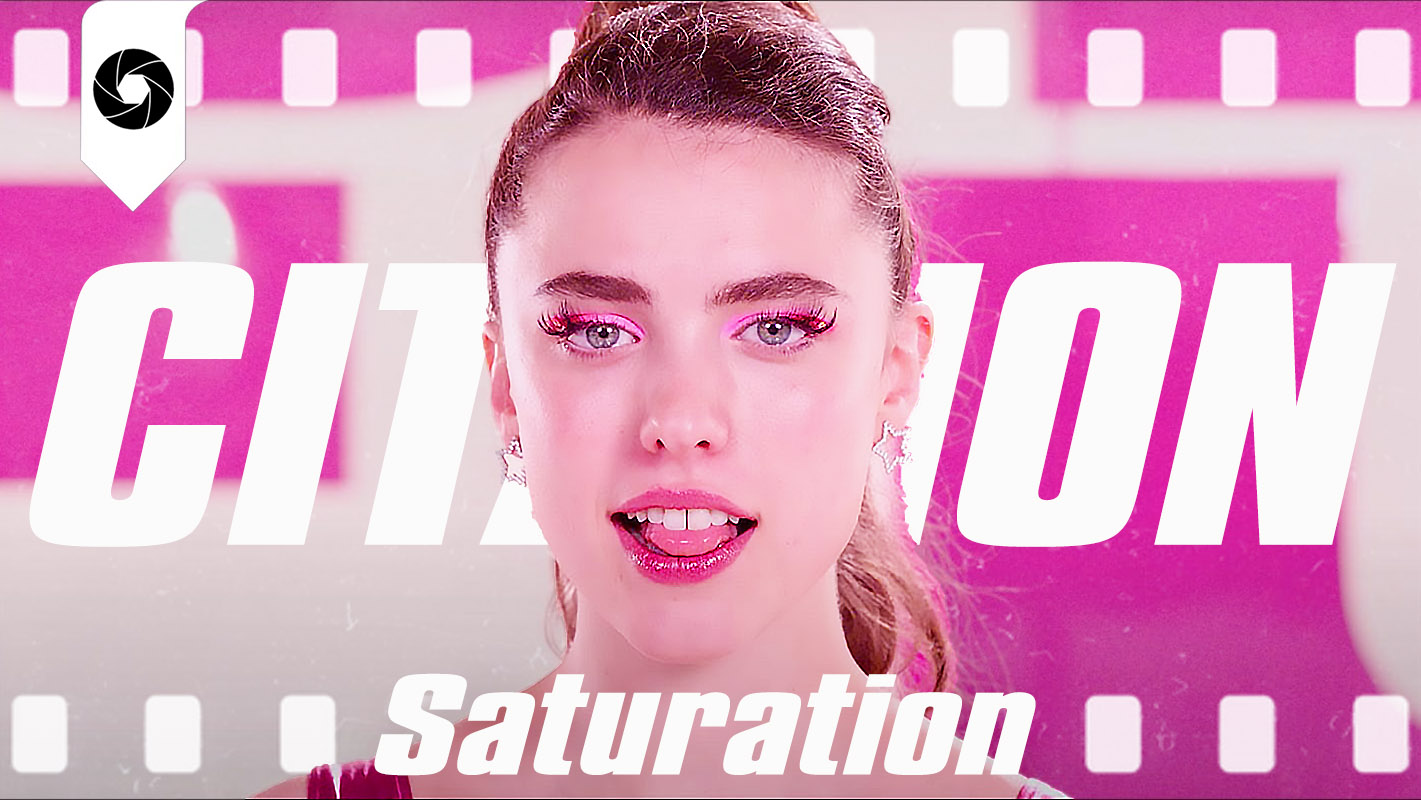
    Margaret Qualley as Sue in ‘Substance’ dir. Coralie Fargeat

    I have the privilege of teaching at the Polish National Film School in Łódź, and I often tell my students that every visual element should serve the story’s core meaning. When watching Substance (2024), directed by Coralie Fargeat, I noticed numerous references to classic films that demonstrate deep cinematic knowledge. However, these references raise an intriguing question about the relationship between homage and narrative purpose.

    A Symphony of Visual References

    Fargeat’s film exhibits clear inspiration from Stanley Kubrick’s “The Shining” (1980). The office corridor sequences employ Kubrick’s signature symmetrical composition, with the camera positioned at the center of long hallways, creating a sense of institutional menace similar to the Overlook Hotel’s infamous passages. The carpet patterns in these corridors even mirror the hexagonal designs from “The Shining,” though serving a different narrative purpose. Most notably, the bathroom scene, where the protagonist accidentally overhears news of her impending termination, borrows Kubrick’s clinical approach to interior spaces – using stark lighting, rigid geometry, sterile white surfaces, and striking use of red color that echo the bathroom scenes from “The Shining.” Just as Kubrick used red as a harbinger of horror in his film’s bathroom sequences, Fargeat employs the same color palette to foreshadow her protagonist’s professional doom.

    The camera placement and movement in this scene particularly recalls Jack Torrance’s conversation with his predecessor, the previous caretaker Grady, in the Overlook’s red bathroom. Both scenes feature characters learning disturbing truths about their professional fate, though in “Substance” the revelation comes through accidental eavesdropping rather than supernatural encounter.

    David Lynch’s influence permeates the film as well. The phone conversation scenes, particularly the extreme close-ups of the woman’s mouth while speaking, directly echo shots from “Lost Highway” (1997). These compositions share Lynch’s distinctive approach to filming facial features and female sexuality, reminiscent of scenes with Patricia Arquette’s character in “Lost Highway.”

    The protagonist’s physical transformation sequence draws clear inspiration from Lynch’s “The Elephant Man” (1980). As the character undergoes her metamorphosis, the visual treatment of her altered form recalls the presentation of John Merrick’s disfigurement. This parallel becomes even more explicit in the gallery scene, where she wears facial covering that closely resembles the protective hood Merrick used to shield himself from public view. This borrowing from Lynch’s visual vocabulary, while technically precise, seems more focused on aesthetic impact than thematic resonance.

    The Question of Purpose

    These references showcase Fargeat’s extensive knowledge of cinema history. The execution is precise, demonstrating technical skill in recreating iconic visual compositions. Yet, as I analyze these citations, I find myself questioning their thematic contribution to the narrative.

    Understanding Hidden Meaning

    The core theme of “Substance” centers on society’s obsession with youth and beauty, particularly in professional environments. It examines how aging women face systematic replacement by younger counterparts, regardless of their competence or experience. This theme manifests through the protagonist’s physical transformation and her struggle against a system that values appearance over substance (pun intended).

    “Youth is currency; experience is expendable.”

    The Power of Purposeful Reference

    To illustrate how cinematic references can reinforce themes, let’s examine Todd Phillips’ “Joker” (2019). The film uses Gary Glitter’s “Rock and Roll Part 2” during a pivotal scene where Arthur Fleck descends the now-famous Bronx stairs in a dance of liberation – notably going down instead of climbing up, symbolizing his embrace of moral descent. The ease and joy of his movement down these same stairs he previously struggled to climb illustrates how natural and liberating his descent into evil has become.

    This choice carries multiple layers of meaning. What’s particularly notable is that the song was specifically written into the screenplay – an unusual choice, as music selection is typically left to the director’s discretion during production. This deliberate inclusion in the script signals the song’s importance as a planned symbolic element rather than a post-production decision. Beyond evoking the period, the song’s performer’s controversial history adds subtext. Glitter’s real-life notoriety for criminal behavior – culminating in his 2015 conviction and 16-year prison sentence for abusing minors – creates an uncomfortable ambiguity that aligns with the film’s exploration of moral transformation.

    The song choice reinforces the theme of evil begetting evil, where Arthur Fleck finds liberation through embracing darkness. I’m certain this symbolic layer will fly over most viewers’ heads – perhaps only 1% of the audience knows about Glitter’s criminal history, especially since he’s not a contemporary artist. Yet this reference still serves its purpose. For the few viewers aware of the context, it creates an additional layer of meaning. For everyone else, the contrast between the song’s cheerful tone and the scene’s dark implications still provokes the intended ambiguous feeling about Arthur’s transformation. This is how a reference should function – working on multiple levels while still serving the story’s core theme, regardless of the viewer’s knowledge of its deeper context.

    A Game of References

    Let’s play a game. If we were to search through cinema history for a scene that could serve as a meaningful reference in “Substance,” what would we look for? The goal would be to find a visual citation that doesn’t just demonstrate cinematic knowledge but actually reinforces the film’s central theme of ageism and professional obsolescence. Instead of references that serve as mere decoration, we’re hunting for one that could deepen the story’s meaning.

    There exists such a reference point in Federico Fellini’s “8½” (1963). In one of the fantasies of Guido, a film director, all the women in his life live together in his “harem,” which is governed by a cruel rule: any woman who grows too old must move upstairs. This fate befalls a former showgirl. She refuses to go. She begs to stay and sets out to prove she still has her old lightness: she starts to dance. But the dance fails her. It is clumsy and strained, and instead of convincing anyone, it only confirms what she so desperately denies. The scene is heartbreaking precisely because Fellini doesn’t spare his character: her body no longer obeys her will. In the end, she climbs the stairs. Literally, she goes “up,” but we all understand it is an exile into oblivion, a place where a woman simply ceases to exist for the world. We witness a microcosm of how society pushes aging women aside once they no longer meet its expectations.

    This scene captures exactly what “Substance” is about: a desperate struggle against one’s own body and an attempt to prove one is still the same person, even though the world has already passed its verdict. Such a reference would have directly reinforced the film’s central idea, that aging women are easily pushed aside and replaced by younger ones, opening a dialogue between past and present about how little has changed in sixty years.

    Of course, this scene from “8½” is just one example from cinema’s vast history. I’m certain there are many other scenes from different films that could playfully reinforce or add depth to “Substance’s” exploration of ageism. What scenes come to your mind? Which film references do you think would meaningfully connect with the theme of professional obsolescence and society’s obsession with youth?

    The Function of Symbolism

    As I teach my students, symbols and references should not merely decorate a film. While Fargeat demonstrates admirable knowledge of cinema history, the citations to Kubrick and Lynch function more as ornamental tributes than thematic reinforcement. The technical execution is impressive, but these references function more as ornamental tributes than thematic reinforcement.

    This analysis isn’t meant to diminish Fargeat’s achievement – after all, competing in the main competition at Cannes, where she won Best Screenplay, is a remarkable accomplishment that speaks to her talent as a filmmaker. My goal with this article is to examine how visual references can either strengthen or distract from a film’s central message. As filmmakers, our primary obligation is to our story’s meaning, with every technical and artistic choice serving that purpose.

    Sources
    Films referenced in analysis:

    • “Substance” (2024) – Directed by Coralie Fargeat, starring Demi Moore, Margaret Qualley and others

    • “The Shining” (1980) – Directed by Stanley Kubrick

    • “Lost Highway” (1997) – Directed by David Lynch

    • “The Elephant Man” (1980) – Directed by David Lynch

    • “Joker” (2019) – Directed by Todd Phillips

    • “8½” (1963) – Directed by Federico Fellini

    Additional Sources:

    • About Gary Glitter’s case – BBC News article

  • When Truth Becomes Unbelievable: An Analysis of Io Capitano

    When Truth Becomes Unbelievable: An Analysis of Io Capitano

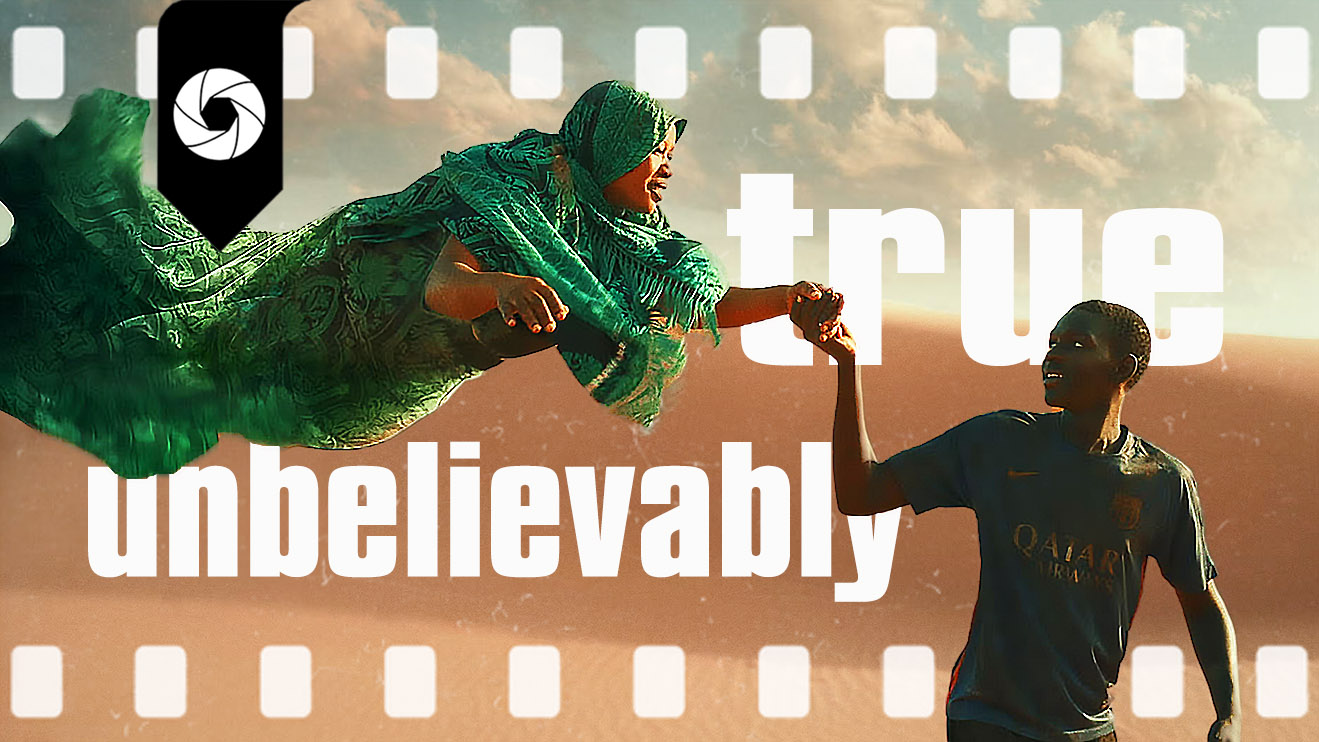
    “Io Capitano”, directed by Matteo Garrone.

    Matteo Garrone’s “Io Capitano” (2023) is a film that will shake you to your core. The story follows Seydou and Moussa, two teenage cousins from Senegal who dream of making it big in Europe. As I watched their harrowing journey from the streets of Dakar through the Sahara Desert and into the treacherous Mediterranean Sea, I found myself needing to pause several times – not because of gratuitous violence or shock value, but because of its devastating authenticity. The film’s raw depiction of the migration crisis is so painfully real that it becomes almost unbearable to watch. Yet, paradoxically, there’s one crucial element of this true story that challenged my suspension of disbelief. But more on that later.

    The Power of Supernatural Elements

    One of the film’s most striking artistic choices is its incorporation of supernatural elements. These moments, where our protagonist encounters an angel or the ghost of a woman who died in the desert, serve as powerful metaphors for the psychological coping mechanisms of those facing unimaginable hardship. These surreal scenes actually enhance the film’s realism by providing insight into the mental state of someone experiencing severe trauma.

    The Power of Odd Numbers in Storytelling

    However, this is where we encounter an interesting lesson in storytelling craft. While these supernatural elements are powerful, their implementation reveals a common pitfall in narrative design. The film presents only two such moments, which brings us to an important principle of storytelling: the rule of odd numbers.

    In narrative construction, symbolic or supernatural elements tend to work best when they appear an odd number of times – typically three, five, or seven occurrences. This isn’t arbitrary; it’s rooted in the psychology of how audiences process patterns and meaning. With two occurrences, elements can feel coincidental or underdeveloped. Three or more creates a clear pattern that audiences subconsciously recognize as intentional.

    Think of classic storytelling examples: three wishes in fairy tales, three ghosts in “A Christmas Carol,” three trials in hero’s journeys. Even in modern storytelling, this principle holds true – consider Christopher Nolan’s “Inception” with its three layers of dreams, or the three time periods in “The Godfather Part II.”

    In “Io Capitano,” a third supernatural encounter could have served multiple purposes:

    – Reinforcing the pattern of psychological coping mechanisms- Providing another emotional peak in the narrative- Creating a more satisfying arc for these symbolic elements- Deepening our understanding of the protagonist’s mental state

    For example, a third supernatural scene could have occurred during the Mediterranean crossing, perhaps showing our protagonist receiving guidance from both the angel and the ghost when he faces his greatest challenge. This would have created a perfect trinity of supernatural encounters, each marking a crucial stage in his journey: the decision to leave, the desert crossing, and the sea voyage.

    The Paradox of Truth

    Now, we arrive at the film’s most challenging aspect – one that initially felt like a misstep but revealed a fascinating paradox about storytelling. The climactic revelation that our young protagonist would captain a boat carrying 250 people across the Mediterranean seemed, to me, completely implausible. As an audience member, I found myself questioning this plot development, feeling that it threatened to undermine the film’s carefully constructed realism.

    Reality That Surpasses Fiction

    Then came the stunning realization that changed everything: this “unbelievable” element was absolutely true. The film follows two teenage friends from Senegal who risk everything to reach Europe, but Garrone crafted the story by combining the experiences of two real individuals: Fofana Amara, who skippered a boat across the Mediterranean at just 15 years old, and Mamadou Kouassi, whose journey through the Sahara and Libya informed the first part of the film.

    The director’s commitment to authenticity is evident in his decision to exclude certain real events because they were too shocking. In interviews, Garrone revealed that some of the actual experiences of migrants, including sexual violence against women and the abuse of children, were deliberately left out of the film. This artistic choice speaks volumes about the horrific reality that even this brutal film only partially depicts.

    What Could Have Made It More Believable? A Director’s Perspective

    This brings us to an interesting observation about truth in cinema: sometimes reality needs additional context to feel authentic on screen. When dealing with extraordinary true events, the audience needs careful preparation to accept what might otherwise seem implausible. As a director who has faced similar challenges in my own work, I’ve learned that just because something actually happened doesn’t mean the audience will believe it.

    In the case of “Io Capitano,” I believe several elements could have helped prepare us for its climactic revelation. Let’s analyze these potential additions in detail:

    1. Building Tension Around the Captain Decision While the film does show us the critical moment when our protagonist initially refuses the smugglers and is then convinced to take on this responsibility, I felt this sequence needed more development. Yes, we see his fear and reluctance in that crucial scene, but the film could have built more context around this life-changing decision. For instance, we could see him secretly observing other potential candidates being approached and refusing, or witness him overhearing conversations about previous teenage captains. We could feel the mounting pressure as the departure date approaches and no experienced captain steps forward. These additional scenes would help us understand not just the moment of decision, but the suffocating lack of alternatives that makes this choice feel inevitable. This way, when he finally accepts, it wouldn’t feel like a sudden plot turn but rather the tragic culmination of a carefully constructed pressure cooker situation.

    2. The Criminal Context Another crucial element that needed more emphasis was explaining to the audience why the smugglers choose migrant captains. During the existing negotiation scene, when our protagonist expresses his reluctance, the smugglers could have revealed the harsh reality of their operation. They could explain how the laws have changed, how professional captains now face decades in prison, and how this has forced them to find alternatives. This context, delivered during this pivotal moment, would not only make the situation more credible for the audience but would also add another layer to our protagonist’s impossible choice. By letting the audience understand this tragic system through this tense exchange, the choice of a teenage captain would feel less like a plot contrivance and more like an inevitable product of cruel circumstances.

    3. The Missing Support System One of the most jarring aspects of the boat scenes is how the other migrants behave. In the film, grown men and women run to our 17-year-old protagonist with every problem – from mechanical issues to medical emergencies. This doesn’t ring true to human nature. What would have worked better is showing a organic support system emerging on the boat. Perhaps a few adults with some maritime experience could help with navigation while others assist with medical emergencies. Our young captain could then be the formal leader – the one who must ultimately make the decisions – while being supported by a realistic network of adults. This would make the power dynamics feel more natural while maintaining the core truth of his responsibility.

    4. Power Dynamics on the Vessel The film shows the migrants almost as passive observers, which feels unrealistic given the life-or-death situation. In reality, people tend to self-organize in crisis situations. The film could have shown this organization process: perhaps some passengers take charge of water distribution, others handle conflicts, while others help with navigation. Our young captain could then be the focal point of these various groups, making final decisions but not carrying the entire burden alone.

    5. The Scale of the Operation While I understand that the real story involved a large vessel, sometimes historical accuracy needs to be balanced against dramatic credibility. A smaller boat would have made the situation more believable for several reasons:

    • It would reduce the implausibility of smugglers risking such a large asset

    • It would make the number of passengers more manageable for our young protagonist

    • It would create a more intimate setting for character development

    • It would still maintain the core truth of the story – a teenager being forced to captain a vessel full of migrants

    These suggestions aren’t about changing the truth but about creating the dramatic infrastructure that helps audiences accept the truth. This is a crucial lesson I’ve learned in my own filmmaking: when reality presents us with extraordinary events, we must work harder to make them believable. Building proper context isn’t about compromising the truth – it’s about helping the audience embrace it.

    Hidden Meaning

    The film’s deeper message explores the complex intersection of desperation, hope, and the human will to survive. Through its unflinching portrayal of the migration crisis, “Io Capitano” reveals how systematic oppression and global inequality force people into impossible situations, where even children must take on unimaginable responsibilities.

    The one-line version that encapsulates this theme would be:

    “When survival demands the impossible, the impossible becomes necessary.”

    “Io Capitano” stands as a powerful reminder that truth can sometimes be stranger than fiction. What makes this film particularly fascinating is how it challenges our preconceptions about what is and isn’t believable. While certain elements of the story might strain credibility, the film’s greatest achievement lies in showing us just how far we still have to go in understanding and depicting the real human cost of the global migration crisis.

    Sources:

    – Real-life ‘Io Capitano’ Skipper Fofana Amara Talks Oscar Hopes & Pleasure That His Story Is Being Told

    – Matteo Garrone on his migration drama: ‘I could only rely on the sound of their voices to tell if they were acting well’

  • Hereditary Explained: A Guide Through the plot

    Hereditary Explained: A Guide Through the plot

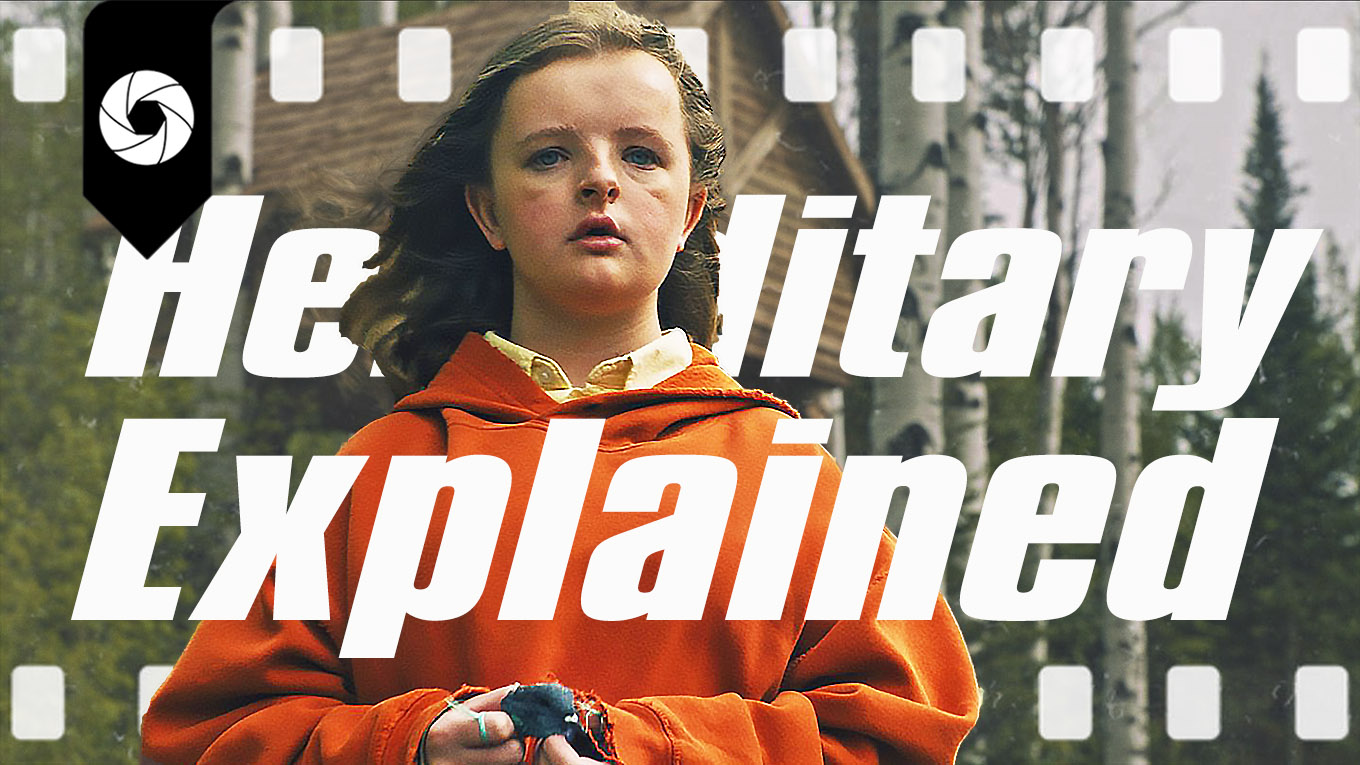
    Milly Shapiro as Charlie in “Hereditary” (2018)

    Hereditary, explained: the family’s grief is the disguise. Underneath it, a cult spends decades bringing a demon, King Paimon, into a human body. The grandmother groomed her granddaughter as Paimon’s first vessel, the girl’s death was the ritual that freed him, and the ending crowns her brother as the demon’s permanent, male host.

    I want to take this film apart the way I would with my students, because Hereditary rewards it. It plays fair. Almost every answer is on screen the first time you watch. You just do not know yet what you are looking at.

    What is Hereditary actually about?

    Ari Aster’s Hereditary (2018, A24) is about a demon-worshipping cult’s long plan to give King Paimon a male body, and about a family that never realises it has been the cult’s project for two generations. On the surface it is a story of mourning. Underneath, every death is a step in a ritual.

    This is why I call Hereditary a modern Rosemary’s Baby. Both films tell the same story: a cult bringing a demon into our world, hidden behind something disarmingly ordinary. In Polanski’s film the disguise is a pair of eccentric, harmless-seeming elderly neighbours who turn out to have arranged the birth of the Antichrist. In Hereditary the disguise is doubled. First there is a mother’s depression and grief, so painfully real that we read everything through it. Then there is, once again, a circle of sweet, kindly old people. Aster baits us with those smiling old ladies, and the twist is that they are the ones who let the demon in.

    Opening on a grieving mother is the first act of misdirection. The family tragedy is the cover story laid over the occult plot. We spend most of the running time asking “is she losing her mind?”, which is exactly the wrong question, and the film knows it.

    What happens in Hereditary? The plot, explained simply

    The film opens with the death of the family’s secretive grandmother. Her daughter, a miniatures artist named Annie, feels more relief and guilt than sorrow; her strange, withdrawn thirteen-year-old granddaughter seems to be the only one who truly grieves. Through a chain of “accidents”, the family is dismantled one member at a time, until the teenage son is possessed and crowned by the grandmother’s cult.

    Here is the chain, in order:

    1. The funeral and the grief group. Among the mourners are strangers who smile a little too warmly. At a support group the mother confesses her history: a father who starved himself in a psychotic depression, and a brother who hanged himself, leaving a note accusing their mother of trying to “put people inside him”. There she meets a warm older woman who befriends her.

    2. The party. The mother makes her son take his little sister to a party. The girl, who has a nut allergy, eats cake with nuts and goes into anaphylactic shock. Racing to the hospital, the son swerves to avoid a dead deer in the road, and his sister, leaning out of the window for air, is decapitated by a telephone pole. In shock, he drives home, goes to bed, and leaves her body for his mother to find in the morning.

    3. The séance. The kindly friend teaches the mother how to contact her dead daughter. It “works”, and from then on something else is in the house.

    4. The discovery. The mother finds photo albums showing the grandmother beside the kindly friend, and a book about Paimon. A phone call tells her the grandmother’s grave has been desecrated; later the headless body turns up in the attic.

    5. The collapse. The mother tries to burn her daughter’s sketchbook, believing that sacrificing herself will break the curse. Instead her husband bursts into flames.

    6. The coronation. The possessed mother pursues her son through the house. He leaps from the attic window, something rises in his body, and it walks to the treehouse, where the naked members of the cult kneel before it.

    Was Charlie’s death planned? What happened to Charlie in Hereditary?

    Yes. The daughter’s death was planned, not accidental. The telephone pole that kills her bears Paimon’s sigil, and the whole sequence is the cult’s way of releasing the demon from a body it never meant to keep.

    The key to the film is that the girl we meet was never quite a girl. Aster has described the film as the story of a long-lived ritual seen from the side of the people being used for it,[1] and on my reading the grandmother prepared Paimon’s place in her from the start, so in a real sense the child we think we know never existed. That is why she feels so off from the first frame: the drawings, the bird she decapitates with scissors, the way she does not belong to her own family. She is the grandmother’s project, the one child the mother let her own mother get close to.

    But Paimon, in the film’s mythology, needs a male host to reach his full power. A girl’s body is a temporary vessel. So the girl has to die, and the method has to be specific. Look at the chain of “coincidences”: the nut cake at a party where, conveniently, no adult checks; the dead deer in the road; the pole marked with the sigil standing exactly where the car swerves. And look at what links every death in the film: the severed head. The pigeon, the girl, the grandmother’s corpse in the attic, and finally the mother. Decapitation is the film’s signature for Paimon.

    People also ask whether she “comes back”. In a way, she does. The tongue click that was her private tic returns at the end from her brother’s mouth, and the cult hails the new host by her name. What comes back is not the girl but the thing that wore her.

    Who is King Paimon in Hereditary, and what did the cult want?

    Paimon is a king of Hell drawn from real occult literature: he appears in the Ars Goetia, part of the seventeenth-century grimoire known as the Lesser Key of Solomon, as one of the spirits a magician could summon.[2] The film adopts him as “one of the eight kings of Hell” and invents its own rules around him, chiefly that he must take a male human host, and that whoever offers him one will be rewarded with knowledge and wealth.

    So the cult’s goal is simple, and patient: give Paimon a male body from the grandmother’s bloodline. The mother’s brother was the first attempt, and his suicide note (“she was trying to put people inside him”) is not madness. It is a confession of what was being done to him. That attempt failed. The father was never a candidate, since he married into the family and is not of the blood. The girl was the stopgap vessel. The son is the prize.

    The mother is not in the cult. She is its victim and its unknowing instrument: her grief, rage and guilt are fuel the cult uses to steer her toward exactly the actions it needs.

    Who is Joan in Hereditary?

    Joan is the cult’s operative on the ground: the kindly older woman from the grief group, the grandmother’s close friend and fellow cult member, posing as a fellow mourner. Her friendship is the trap.

    Played with great warmth, she is the Rosemary’s Baby type exactly, the friendly, chatty older woman bearing comfort, and the misdirection works on us as well as on the mother. She teaches the séance, which is the door the cult needs opened. She chants a strange incantation across the schoolyard at the son. And the photo album the mother discovers later, showing this woman beside the grandmother, is the moment the whole film flips.

    What does “Zazas, Zazas, Nasatanada Zazas” mean? Satony and Liftoach Pandemonium

    “Zazas, Zazas, Nasatanada Zazas” is a real occult formula. Aleister Crowley used it in his 1909 working to summon the demon Choronzon and in his self-initiation rite, and occult tradition reads it as a call to open the gates of Hell.[4] In Hereditary it works as a summoning: the cult reaching through the walls of the house toward the son.

    The other searched-for words are written faintly on the walls, where you only notice them on a second viewing. “Satony” and “Liftoach Pandemonium” belong to the same incantatory vocabulary. “Liftoach” is commonly read as Hebrew for “to open”, so the phrase reads as “open Pandemonium”, Pandemonium being Milton’s name for the capital of Hell in Paradise Lost. I would treat “Satony” more carefully. It functions in the film as a word of invocation alongside “Zazas”, and I would not trust anyone who gives you a confident dictionary definition of it.

    What matters more than etymology is function. These words are the cult’s handwriting inside a home whose family never sees it, which is the whole film in miniature. And “desecrated”, the other word people look up, is simply what the cemetery tells the mother on the phone: her mother’s grave has been disturbed.

    Hereditary ending explained: the treehouse and Paimon’s coronation

    The ending is a coronation. The son’s body, now fully occupied by Paimon, climbs into the treehouse, where the cult has built a shrine around the girl’s severed, crowned head, with the headless bodies of the grandmother and the mother kneeling before it. The kindly friend from the grief group crowns him, addressing him as “Charlie” and naming him King Paimon.

    Why does the son finally break? Paimon needs the host’s will to give way. The school scene, where an invisible force slams the boy’s face into his desk, is the demon trying the door. The final night, with his mother crawling on the ceiling and severing her own head with wire, is the door kicked in. When the son jumps from the attic window, the trauma empties him, and a small light drifts into his body. He stands up, clicks his tongue, and walks to the treehouse.

    The cult calls him by his dead sister’s name because that is the only identity Paimon has worn among them. The demon spent thirteen years in the girl’s body, and the name has transferred with the occupant. The cult’s address, hailing King Paimon as one of the eight kings of Hell and offering him the crown, mirrors the final scene of Rosemary’s Baby almost beat for beat: the smiling old believers gather around the newborn ruler and proclaim his reign. “Hail, Paimon.”

    No survivor, no doubt: this is the cult’s happy ending.

    The hidden meaning of Hereditary

    Now that the puzzle is solved, I want to be honest about what kind of film this is, because much writing about it gets this wrong. It is often described as a profound film “about grief” or “about inherited trauma”, as if the demon were a metaphor. I do not think it is. Hereditary does not work like most “deep” films. It tells itself through plot. Paimon’s arrival in the world is literally the solution to the mystery, not a spiritual revelation you feel your way toward. The film is a puzzle, and both the pleasure and the horror are in the solving.

    That is not a weakness. It is Aster’s method, and it is exactly why an explainer is the right way to meet this film: it wants to be decoded. Its meaning is its mechanism. The grief is real, and Toni Collette plays it with ferocious truth, but grief is the disguise, not the subject. The subject is a plan, and its lineage is Rosemary’s Baby. So my reading of what the film is really about comes down to this:

    Evil in Hereditary does not break into the family from outside. It is patiently invited in by the nicest people in the room, and the family’s own grief is the costume it wears on the way through the door.

    The film never states this outright. It is carried by the staging, by who the camera teaches us to trust, and by the slow reveal that the kindest faces were the trap. And if I had to carry one line onto set, the beacon that keeps every scene honest, it would be shorter:

    The devil does not arrive in a storm. He arrives wearing the face of a grieving family and a circle of harmless old ladies.

    How Aster makes you look the wrong way (the craft of misdirection)

    As a filmmaker, what I notice is that the misdirection lives in the form as much as in the script, pointing your attention at the most sympathetic faces in the frame so you never think to suspect them.

    Start with the opening shot. The camera glides across the mother’s workshop and pushes into one of her model houses: the son’s bedroom. Without a cut, the miniature becomes the real room, and the father walks in to wake him. Before a single line of dialogue, Aster has told us the theme. These people are figures in a model, arranged by an unseen hand. They were never free. The cult was holding them from the beginning, and the mother’s art, recreating her own life in tiny rooms, is a sad echo of a woman who thinks she is the one doing the arranging.

    Then watch how the camera frames the house. Aster favours static, symmetrical compositions and long holds, often looking into rooms as if from outside, like a dollhouse with its wall removed. The stillness makes you scan the frame, and he rewards the scanning with figures standing in dark corners, smiling, that you may not consciously register. The cult is literally in the background of the family’s life, and the composition puts it there.

    Sound does the same work. The girl’s tongue click is planted as a character tic and paid off as plot: later it marks Paimon’s presence, in the dark of the house at night and finally from the son’s mouth.

    The biggest trick, though, is casting the ordinary. Polanski hid Satanists in a nosy elderly couple; Aster hides them in a grief group and a crowd of nodding funeral guests. Every choice of performance and framing teaches us to trust the old ladies and fear the mother, and the final shock is realising we were watching the wrong person the whole time.

    Seeing that second film running underneath the first, the one the camera and the staging are quietly telling you, is a skill, and it can be learned.

    If you want to learn to see that second film, the choices a director makes that an audience feels but never notices, that is exactly what I teach in Understanding Films: Decode the Invisible Meaning.

    Quick answers

    Does the dad die in Hereditary, and why?

    Yes. The mother believes destroying her daughter’s sketchbook will sacrifice herself and break the curse, but when she throws it into the fire, it is her husband who burns. On my reading, he was never of the bloodline and of no use to the cult, so the film simply removes him.

    What disease does the girl in Hereditary have?

    In the story, the daughter has a severe nut allergy, which is what triggers the fatal car ride. Her distinctive look comes from the actress herself, Milly Shapiro, not from the story.

    Is Hereditary based on a true story?

    No. The cult and the possession are fiction, though Paimon himself comes from real occult literature. Aster has spoken about drawing on painful feelings and a run of blows that struck people he loves,[3] which may be why the drama feels so real.

    Who is in the cast of Hereditary?

    Toni Collette plays the mother, Alex Wolff the son, Milly Shapiro the daughter, Gabriel Byrne the father, and Ann Dowd the kindly friend from the grief group.

    Sources

    1. Ari Aster interview: Hereditary, horror cinema — Den of Geek ↩
    2. Ari Aster Had A Practical Reason For Putting Paimon In Hereditary — SlashFilm ↩
    3. How Ari Aster made the best horror movie of 2018 — Dazed ↩
    4. Aleister Crowley’s The Vision and the Voice: An Introduction — Marco Visconti ↩
  • Trainspotting Explained – Decoding the Real Message Behind Danny Boyle’s Bildungsroman

    Trainspotting Explained – Decoding the Real Message Behind Danny Boyle’s Bildungsroman

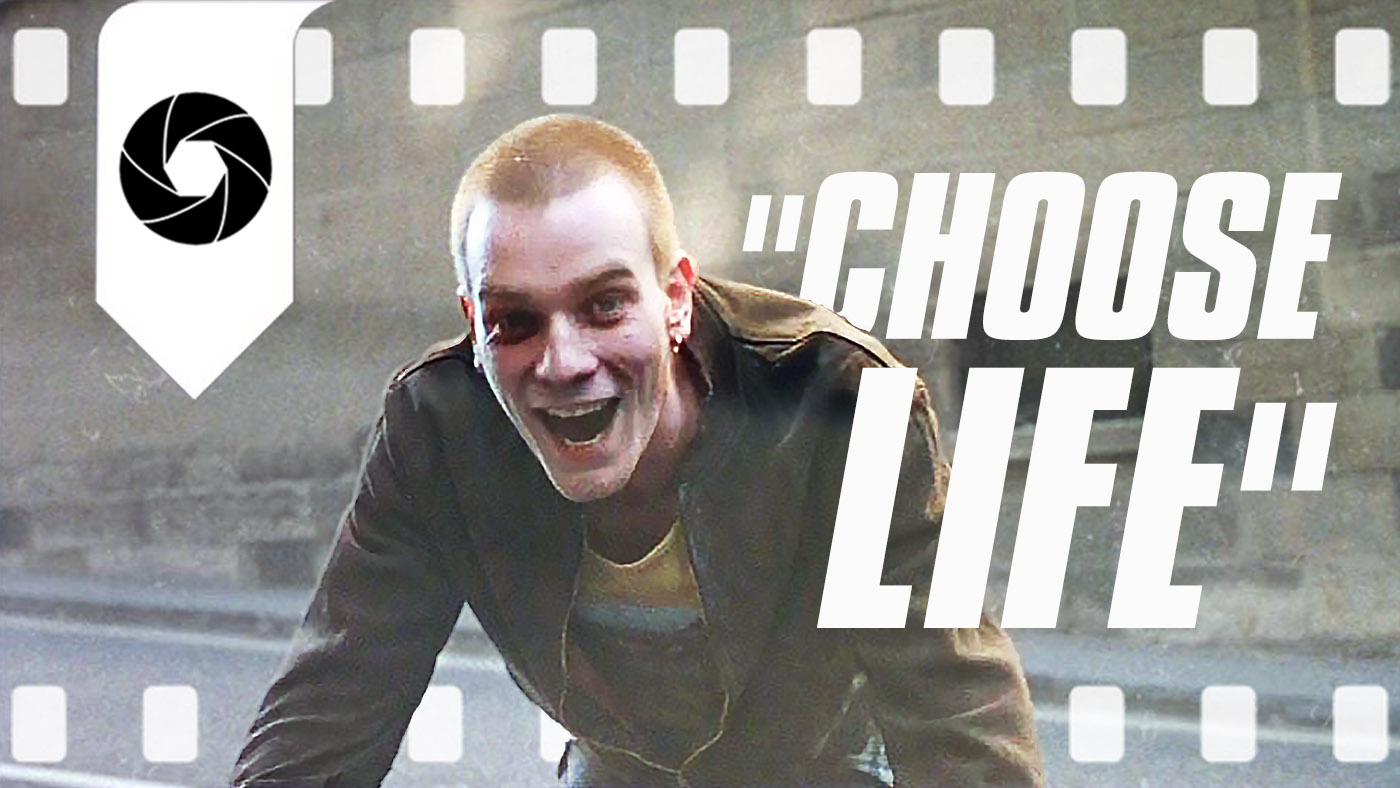
    Evan McGregor in “Trainspotting” 1996

    Danny Boyle’s “Trainspotting” (1996) shocked audiences with its frenetic style and unflinching portrayal of Edinburgh’s drug scene. But beneath its provocative surface lies a sophisticated tale about growing up in a world where both rebellion and conformity seem equally toxic. Through its complex layers of narrative and metaphor, the film tells us something profound about the journey from youth to adulthood that many viewers might have missed on their first viewing.

    The Mystery Behind the Title

    The term “trainspotting” traditionally refers to a British hobby where enthusiasts observe and record train numbers at railway stations. However, in the context of the film, the title takes on a deeper metaphorical meaning. Just as trainspotters obsessively track passing trains that lead somewhere else, the characters in the film are stuck in their own form of obsessive behavior – drug addiction – watching life pass them by while remaining stationary themselves.

    Bildungsroman in Disguise

    While “Trainspotting” is often categorized as a drug film, its narrative structure reveals a classic bildungsroman – a German literary term for a coming-of-age story that follows a young person’s journey to adulthood. Just as works like “Great Expectations” or “The Catcher in the Rye” chart their protagonists’ path to maturity, “Trainspotting” follows Mark Renton’s transformation from lost youth to self-aware adult. Through Ewan McGregor’s brilliant portrayal, we see how Renton’s heroin addiction serves as a metaphor for arrested development.

    The film masterfully incorporates the essential phases of personal transformation:

    • Beginning Phase: We meet Renton trapped in the destructive cycle of heroin dependency

    • The Great Escape: His bold decision to leave Edinburgh’s toxic environment for a fresh start in London

    • Battle for Change: Renton faces multiple challenges, from the physical torment of withdrawal to the psychological pull of his old life and friends

    • Moment of Truth: The high-stakes drug deal becomes the crucible where Renton must decide who he truly wants to be

    • Metamorphosis: His final decision to “choose life” marks his emergence into authentic adulthood

    Full names mean developed characters

    One of the film’s subtle but powerful narrative devices is its use of names. Mark Renton and Francis Begbie are the only characters consistently referred to by their real names, while others remain known by nicknames – Spud, Sick Boy, and Tommy. This distinction becomes significant when we realize that Begbie, despite his violence, never uses heroin, and Renton eventually breaks free from addiction. The nicknames represent a state of arrested development, while real names signify adult identity.

    Symbols of Transformation

    Boyle uses mirror scenes at the beginning and end of the film to chart Renton’s evolution. In the opening, we see a gaunt, hollow-faced addict staring back from the reflection, while the final mirror scene presents a healthier, more composed individual. This visual transformation reinforces the film’s theme of personal growth and change, showing us physically what has changed within.

    The film’s famous “Choose Life” speeches serve as equally powerful markers of Renton’s evolution. The opening monologue drips with youthful cynicism and rebellion, as Renton viciously mocks societal norms and expectations. When these same words return at the film’s conclusion, they carry an entirely different weight – no longer targets for mockery, but a genuine manifesto for living. Through these parallel speeches, we witness Renton’s journey from cynical youth to self-aware adult.

    The Dark Trinity: Three Narrative Elements of Horror

    While “Trainspotting” pulses with vibrant colors, kinetic energy, and an iconic soundtrack that could make heroin addiction seem almost glamorous, Danny Boyle deliberately weaves three devastating narrative elements that expose addiction’s true horror:

    1. Baby Dawn’s death stands as the film’s most gut-wrenching portrayal of collateral damage. The scene’s power comes not just from the discovery of the infant’s body, but from the way Boyle frames the collective denial of the addicts who had been too high to notice the baby’s deterioration.

    2. Tommy’s fate serves as both the film’s most brutal cautionary tale and a dark mirror of Renton’s potential future. His transformation from a healthy, athletic young man to an HIV-positive addict living in squalor is particularly haunting. What makes Tommy’s story even more tragic is Renton’s unwitting role in his destruction – first by stealing the sex tape that leads to Tommy’s breakup, then by providing his first hit of heroin. As Tommy deteriorates, eventually dying alone in a squalid apartment surrounded by cat feces and heroin paraphernalia, we witness a chilling role reversal: while Renton climbs out of addiction, Tommy descends into it. It’s as if they trade places, with Renton’s path to salvation inadvertently paved by Tommy’s sacrifice, making his eventual escape even more poignant and morally complex.

    3. Renton’s withdrawal represents the film’s descent into psychological horror. Through hallucinations, including the infamous “baby on the ceiling” scene, Boyle creates a surreal nightmare that captures the mental and physical agony of heroin withdrawal. This departure from the film’s usual style emphasizes the traumatic nature of getting clean.

    These narrative elements serve as crucial counterpoints to the film’s otherwise energetic style. Boyle understood that to tell an honest story about addiction, he needed to balance the allure of drug culture with its devastating consequences. The horror elements ground the film’s more stylized moments in brutal reality.

    A Satisfying Betrayal

    The film’s conclusion offers a unique form of audience gratification through Renton’s betrayal of his friends. What would normally be seen as an act of treachery instead feels like justice served, particularly after we witness how his so-called friends have become a destructive force in his life. This becomes painfully clear when Begbie invades Renton’s small London apartment, terrorizing him and making a mess, followed by Sick Boy who arrives only to sell Renton’s TV set. These scenes effectively demonstrate how Renton has outgrown his old circle, with his former friends now acting as anchors dragging him back to his old life.

    The distribution of consequences feels perfectly calibrated: Begbie, the violent sociopath who terrorized his friends while hypocritically looking down on drug users, ends up in prison where his aggressive nature finally meets its match. Sick Boy, the manipulative friend who (claimed by Renton) never misses an opportunity to exploit others, gets a taste of his own medicine. Most satisfyingly, Renton leaves money for Spud, the film’s most genuinely sympathetic character, offering him a chance at redemption that feels earned.

    This ending works because it maintains moral complexity while delivering emotional satisfaction. Renton’s betrayal isn’t purely noble — he’s still stealing from his friends — but it represents a necessary severing of toxic bonds. The audience leaves feeling that while crime doesn’t pay, sometimes a well-executed betrayal can be the first step toward redemption.

    The Hidden Meaning

    The deeper meaning of “Trainspotting” lies in its exploration of choice and responsibility in modern society. Through Renton’s journey, the film examines how individuals navigate between complete rejection of societal norms (represented by drug addiction) and mindless conformity to consumerist culture.

    The longer version of the hidden meaning would be:

    “In a world of extremes between self-destructive rebellion and mindless conformity, true maturity means finding one’s own path while accepting the responsibilities of adult life.”

    The director’s one-liner version:

    “Choose your own path, not society’s escape routes.”

    The Cultural Impact

    “Trainspotting” transcended its modest budget to become a defining film of the 1990s. Its unflinching portrayal of addiction, combined with stylish direction, a pulsing soundtrack, and dark humor, created a new template for British cinema. The film launched the careers of several actors, including Ewan McGregor, Robert Carlyle, and Kelly Macdonald, while cementing Danny Boyle’s reputation as a director of unique vision. Through its complex narrative layers, the film presents a universal story about growing up and finding one’s place in the world. It reminds us that choosing life isn’t about conforming to society’s expectations, but about taking responsibility for our own path forward.

  • Annihilation: A Journey Through Trauma and Transformation

    Annihilation: A Journey Through Trauma and Transformation

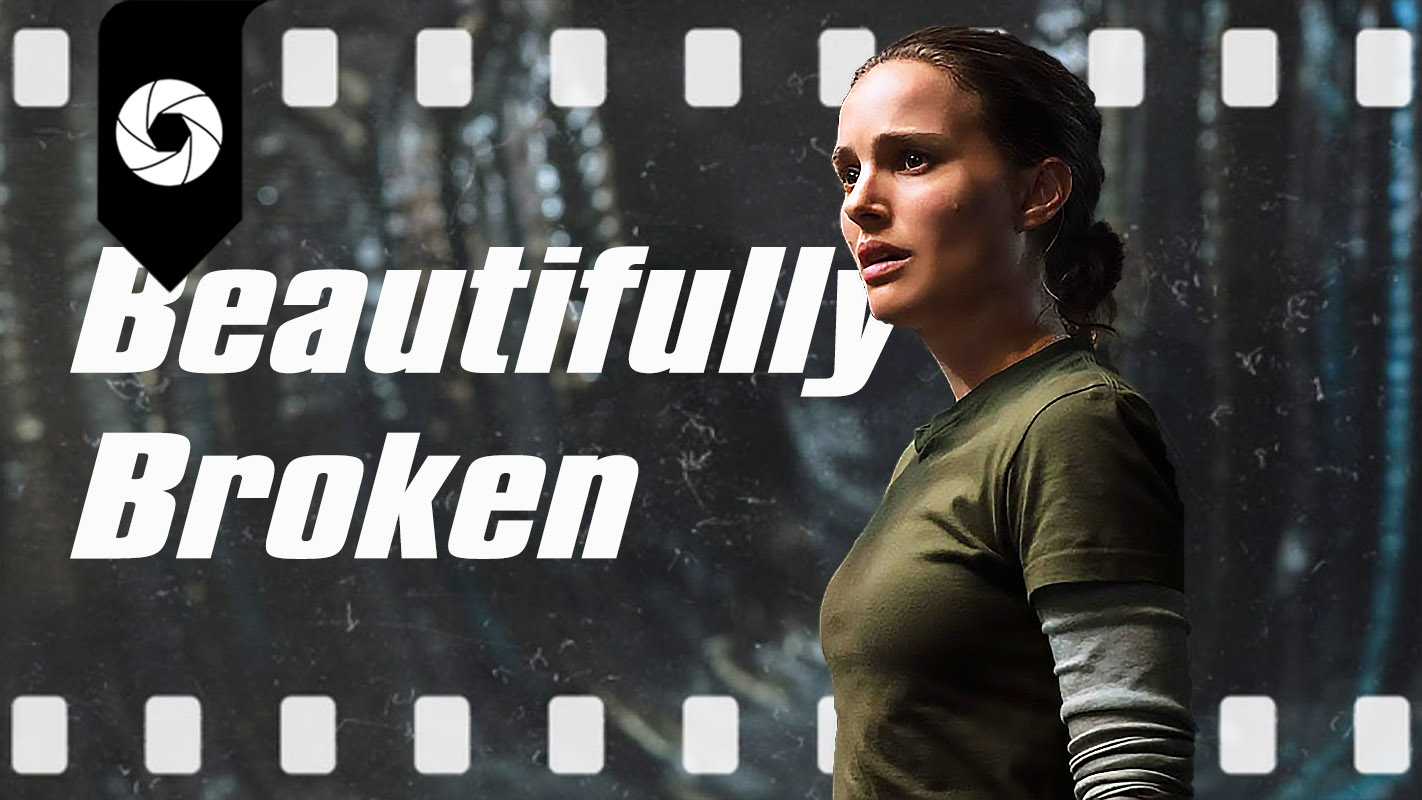
    Natalie Portman in Annihilation (2018)

    As a filmmaker, I’m always drawn to movies that delve beneath the surface, using metaphor and symbolism to explore profound human experiences. One such film is Alex Garland’s 2018 sci-fi thriller “Annihilation,” starring Natalie Portman. On the surface, it’s a mind-bending tale of a mysterious alien zone and the expedition team sent to investigate it. But beneath the stunning visuals and unsettling atmosphere lies a poignant meditation on trauma, change, and the human struggle to adapt and heal.

    The Trauma of Infidelity

    At the heart of “Annihilation” is the relationship between Lena (Natalie Portman), a biologist and former soldier, and her husband Kane (Oscar Isaac). When Kane returns from a secret mission, altered and seriously ill, Lena joins the next expedition into “The Shimmer,” the alien zone that Kane’s team explored, desperate for answers.

    But Lena carries her own trauma: guilt over an affair she had while Kane was away. This infidelity looms large, a wound in their marriage that hasn’t healed. Lena’s journey into The Shimmer becomes a confrontation not just with the alien unknown, but with the consequences of her own actions and the fragility of human relationships in the face of betrayal.

    A Team of “Damaged Goods”

    Lena isn’t alone in her pain. The all-female team that ventures into The Shimmer is a group of “damaged goods,” each carrying their own scars. Anya Thorensen (Gina Rodriguez) struggles with self-destructive impulses and suicidal thoughts. Dr. Ventress (Jennifer Jason Leigh), the team’s psychologist and leader, is dying of cancer. Cass Sheppard (Tuva Novotny) is haunted by the loss of her daughter. Josie Radek (Tessa Thompson) self-harms, her body a map of past pains.

    These women are not defined by their traumas, but shaped by them. They carry their wounds into The Shimmer, each hoping, perhaps, for answers, for absolution, for a chance to confront and make peace with their demons. In this way, “Annihilation” acknowledges the prevalence of trauma, the way it touches so many lives, often unseen.

    The Shimmer as Trauma Incarnate

    And what of The Shimmer itself, that unearthly realm where DNA is refracted, where the rules of nature are rewritten? In the language of metaphor, The Shimmer is trauma made manifest. It’s an external force that infiltrates, that changes things on a fundamental level. Like trauma, it doesn’t discriminate. It doesn’t judge. It simply is, and those who enter it must grapple with the changes it brings.

    Consider the words of Dr. Ventress: “It’s not like us. It’s unlike us. I don’t know what it wants, or if it wants, but it’ll grow until it encompasses everything. Our bodies and our minds will be fragmented into their smallest parts until not one part remains…annihilation.”

    Trauma, too, can feel like annihilation – a shattering of the self, a fragmenting of identity. It can change the very core of who we are. And like the characters in the film, we must decide how we will respond to that change. Will we fight it, resist it, be broken by it? Or will we, like Lena and Kane at the end, find a way to integrate it, to accept the selves we’ve become?

    Acceptance and Transformation

    In the film’s enigmatic conclusion, Lena and Kane, both irrevocably changed by their encounter with The Shimmer, embrace. They are not the same people they were. They may not even be fully human anymore. But they have survived, and they have found a way to love each other anew.

    It’s a powerful metaphor for the aftermath of trauma. We are changed by our wounds, sometimes in ways that feel alien even to ourselves. But healing is possible. Love is possible. We can learn to accept the selves we’ve become, to find meaning and connection in the wake of even the most shattering experiences.

    “Annihilation” is a haunting, challenging film, one that lingers long after the credits roll. It’s a testament to the power of science fiction to illuminate the most intimate of human struggles, and a reminder that even in the darkest of places, there is always a path forward. As Lena says in the film’s final moments, “I’m not sure what I am. But I know I’m not alone.”

    The Prismatic Nature of Trauma

    One of the most striking visual motifs in “Annihilation” is the prism. Throughout the film, we see instances where light is refracted, split into its constituent colors. This serves as a powerful metaphor for the way trauma can break us, fragmenting our identities and our understanding of the world.

    Consider the scene where Lena is in her classroom, explaining the properties of light to her students. As she holds up a prism, the light splits into a rainbow spectrum. This moment foreshadows Lena’s own journey into The Shimmer, where she will be broken down and changed by her encounter with the alien.

    We see this symbolism again when the team is inside The Shimmer. In one scene, they sit around a table, light filtering through water glasses and casting prismatic rainbows on their faces. It’s a moment of quiet before the storm, a suggestion that these women, already fragmented by their individual traumas, will be further transformed by what they encounter.

    The Rainbow Hues of Change

    The rainbow colors that suffuse The Shimmer are another key symbol. The lush, mutated landscape is alive with vivid hues, from the iridescent plant life to the shimmering, multi-colored deer. Even the ominous “screaming bear” is marked with a rainbow sheen. These colors are beautiful, but they’re also unsettling, a visible manifestation of the way The Shimmer changes everything it touches.

    In a sense, these rainbow hues represent the spectrum of possible responses to trauma. Some, like the aggressive alligator or the monstrous bear, are twisted, warped by their experience into something dangerous, even malevolent. Others, like the eerily beautiful plants or the mesmerizing crystal trees, find a strange, new kind of harmony in their transformation.

    For Lena and her team, the challenge is to navigate this spectrum of change, to find a way to integrate their experiences without losing themselves entirely. In one pivotal scene, Josie embraces the change quite literally, allowing herself to be absorbed into the prismatic landscape. It’s a moment that’s both unnerving and strangely peaceful, a suggestion that surrender, too, can be a form of acceptance.

    Seeing the Self in a New Light

    Ultimately, the prism and rainbow symbolism in “Annihilation” invites us to consider trauma not just as a shattering force, but as an opportunity for transformation. Just as white light contains all colors, perhaps our identities contain multitudes, possibilities that are only revealed under the pressure of life-altering experiences.

    This idea is embodied in the film’s enigmatic ending. As Lena and Kane’s doppelgangers embrace*, their eyes shimmer with an otherworldly iridescence. They have been through the prism of The Shimmer and come out the other side changed, but not necessarily broken. Their love, too, has been refracted, transformed into something new and strange, but no less real.

    In the end, “Annihilation” suggests that trauma, for all its destruction, can also be a catalyst for growth and change. It invites us to look at ourselves and our experiences through a new lens, to see the rainbow within the fractured light. It’s a challenging vision, but also a hopeful one, a reminder that even in the depths of our brokenness, there is always the potential for something new to emerge.

    As Lena says, “It’s not destroying. It’s making something new.” Perhaps, in the face of trauma, that’s all we can hope to do – to find a way to make something new from the shattered pieces of ourselves. “Annihilation” gives us a glimpse of what that might look like, in all its strange, prismatic beauty.

    Hidden Meaning

    Deciphering the hidden meaning in “Annihilation” is crucial to fully appreciating the film’s depth and complexity. The hidden meaning of a film is the underlying message or theme that the filmmaker aims to convey through the story, characters, and symbolism, without explicitly stating it in the dialogue or narration. In the case of “Annihilation,” the hidden meaning appears to be:

    The transformative power of trauma and the individual’s choice to either be consumed by it or to embrace the change it brings, leading to a new understanding of oneself and the world.

    This message is never directly expressed in the film but is instead reinforced through the metaphorical landscape of The Shimmer, the characters’ emotional journeys, and the symbolic elements woven throughout the narrative.

    “What doesn’t kill you changes you”

    is a poignant and fitting encapsulation of the film’s central theme. This shorter version of the hidden meaning directly connects to the idea of transformation and the profound impact of traumatic experiences. The word “changes” suggests a significant alteration in one’s being, highlighting the transformative power of adversity and the resilience of the human spirit.

    This concise statement captures the essence of the film’s message in a thought-provoking and memorable way. It serves as a powerful reminder that life’s most challenging experiences, while not fatal, have the capacity to fundamentally reshape our understanding of ourselves and the world around us.

    As a guiding principle for the director during the filmmaking process, this short phrase encapsulates the core idea that should inform every creative decision. It can be easily recalled and applied on set, ensuring that the film remains true to its central theme and emotional resonance. By keeping this proverb in mind, the director can create a haunting, introspective cinematic experience that encourages audiences to reflect on the transformative power of trauma and the strength of the human spirit in the face of adversity.

    In a world where trauma touches so many lives, that’s a message worth holding onto.

    __________________________________________

    *Technically speaking, Kane is an alien doppelganger, while Lena, on the other hand, is herself but has been contaminated by the alien, so she is not entirely human anymore.

  • Suspense vs. Surprise: Analyzing Hitchcock’s Mastery in North by Northwest

    Suspense vs. Surprise: Analyzing Hitchcock’s Mastery in North by Northwest

    Alfred Hitchcock’s 1959 spy thriller “North by Northwest” stands as one of cinema’s greatest achievements, earning its place in the National Film Registry and consistently ranking among the greatest films ever made. While the film is celebrated for many reasons – from Ernest Lehman’s razor-sharp screenplay to Bernard Herrmann’s iconic score – today we’ll focus on one particular aspect of Hitchcock’s genius: his masterful manipulation of suspense and surprise.

    The Master Explains

    In a fascinating interview, Hitchcock himself explained the crucial difference between suspense and surprise in filmmaking:

    “There is one difference between what I prefer to make and very often what you see… I prefer to suggest something and let the audience figure it out.”

    The director famously illustrated this concept with an example of two people sitting at a table with a bomb underneath. If the audience knows about the bomb while the characters remain unaware, every moment of their casual conversation becomes unbearably tense – that’s suspense. If neither the audience nor the characters know about the bomb until it suddenly explodes, that’s surprise. Both techniques have their place in storytelling, and “North by Northwest” masterfully demonstrates the effective use of both.

    Setting Up the Stakes: The Path to the Hotel Room

    Before the hotel room scene unfolds, we’ve witnessed Roger Thornhill’s terrifying ordeal. Mistaken for a man named George Kaplan, he was kidnapped by thugs working for the mysterious Phillip Vandamm, nearly killed in a staged drunk-driving accident. Now, determined to uncover the truth about the real Kaplan, Thornhill convinces his skeptical mother to help him investigate. They manage to get the key to Kaplan’s hotel room by deceiving the receptionist. The stakes are clear: Thornhill is walking into the lion’s den, and any wrong move could be fatal.

    The Art of Suspense: The Hotel Room Scene

    In the hotel room scene, both Thornhill and the audience know he’s in danger. After surviving an attempt on his life, Thornhill deliberately enters Kaplan’s hotel room, seeking answers about the man he was mistaken for. What makes this scene particularly tense is not that Thornhill is unaware of the danger, but rather that both he and the audience are acutely aware of the precarious situation.

    The suspense in this scene comes from several layers of danger: the thugs who tried to kill Thornhill might return at any moment, the hotel staff could realize they’ve been deceived about the key, and most importantly, Thornhill is searching for answers in a place that belongs to someone who might be connected to his would-be killers. The audience feels this mounting tension with each small interaction – the phone calls, the valet’s delivery, the way everyone addresses Thornhill as Kaplan – because we understand that any of these moments could expose him or bring his enemies to his location.

    The Path to Betrayal: Setting Up the Shooting

    By the time we reach the shooting scene, the story has grown more complex. Thornhill has fallen in love with the mysterious Eve Kendall, only to discover she’s working with Vandamm, the man trying to kill him. However, we learn that Eve is actually an undercover agent, and her relationship with Vandamm is part of her mission. Vandamm, growing suspicious of Eve’s loyalty, needs proof of her commitment. This sets the stage for a crucial confrontation at Mount Rushmore, where Thornhill demands Eve’s release, putting all parties in a seemingly impossible situation.

    The Power of Surprise: The Shooting Scene

    Hitchcock demonstrates his mastery of surprise in a scene that plays with audience expectations. When Thornhill meets with Vandamm to negotiate Eve’s release, we follow events from the same perspective as the villain. Eve suddenly draws a gun and shoots Thornhill, an action that comes as a complete shock. The audience, sharing Vandamm’s point of view, believes they’ve just witnessed a genuine murder. Only later do we discover that the shooting was staged, a revelation that recontextualizes everything we thought we knew. Eve and Thornhill staged his death, to trick Vandamm. This scene works because Hitchcock deliberately withholds information from both the audience and Vandamm, making the surprise equally effective for both.

    The Director’s Choice

    The question then becomes: when should a filmmaker choose suspense over surprise or vice versa? The answer lies in understanding the emotional impact you want to achieve. Suspense creates sustained tension, drawing out the audience’s anxiety and engagement over time. Surprise delivers a sharp emotional jolt, perfect for dramatic turning points and revelations.

    Hitchcock’s genius lay in knowing exactly when to employ each technique. In “North by Northwest,” he creates a perfect balance between sustained suspense sequences (like the famous crop-duster scene) and shocking surprises (like Eve’s apparent betrayal), demonstrating why he earned the title “Master of Suspense.”

    The film’s enduring influence can be seen in countless subsequent works, from the James Bond franchise to modern action thrillers. Its sophisticated handling of suspense and surprise continues to serve as a masterclass for filmmakers today, proving that sometimes the most effective way to engage an audience is not through what happens on screen, but through what they know – or don’t know – about what’s about to happen.

  • Limitations of Modern CGI: How Creator Finds the Workaround in Performance Capture

    Limitations of Modern CGI: How Creator Finds the Workaround in Performance Capture

    “The Creator” 2023 dir. Gareth Edwards

    In the ever-evolving landscape of cinema, we occasionally encounter films that challenge our perceptions and push the boundaries of what’s possible on screen. “Creator” is one such film – a fascinating spectacle that presents a curious duality between on-point visual effects and conventional storytelling. While the narrative left me wanting more, I must admit that the approach to visual effects is remarkably effective. Let’s explore both aspects of this intriguing cinematic offering.

    Stale Story Structure: Predictability in “Creator”

    The tapestry of “Creator” is woven with the thread of a very predictable story structure, adhering rigorously to the eight-sequence approach with a turning point every 15 minutes. The film’s plot-driven nature becomes evident early on, with characters relegated to mere shells navigating a well-trodden path. The lack of deviation from the expected beats leaves viewers craving innovation and depth.

    The absence of character development compounds the issue, robbing the protagonists of meaningful arcs. In a world driven by plot rather than character evolution, the emotional investment from the audience wanes, creating a disconnect that hampers the overall viewing experience.

    Formulaic Chase Sequences: A Familiar Rambo Resonance

    “Creator” introduces us to a protagonist who, unfortunately, bears a striking resemblance to the iconic Rambo archetype. The narrative unfolds with high-ranking military officials coercing the protagonist into a mission, a trope worn thin by countless iterations in cinematic history. The echoes of familiarity dilute the impact, rendering the storyline a collage of pursuits we’ve witnessed in numerous action-packed tales.

    Superficial Attempts at Depth: Antagonists and Their Shallow Backstories To its credit, “Creator” attempts to inject a modicum of depth into its characters, particularly the antagonists. The main antagonist, a grieving mother who lost her sons in the war with robots, and the poignant farewell of a marine (he presumably wants to tell his wife that he loves her), hint at an effort to humanize these figures. Yet, these attempts feel disjointed, almost forced into the narrative without seamlessly integrating with the overarching story.

    The villains’ dialogues about family are mere emotional placeholders, added to elicit empathy in specific scenes, rather than contributing to the holistic development of these characters. The film falls short of revealing the humanity behind their sinister acts, leaving these moments feeling contrived and emotionally detached.

    Balancing CGI Marvels with Narrative Innovation

    “Creator” presents a paradoxical juxtaposition of groundbreaking CGI and a narrative trapped in the conventions of its genre. While the visual effects team pushes the boundaries of what is possible in portraying robots with human-like features, the storytellers remain tethered to a formulaic approach. As we marvel at the stunning visuals, it’s a reminder that true cinematic magic arises when technological brilliance converges with innovative storytelling. In the case of “Creator,” the challenge lies in breaking free from the shackles of predictability and allowing the narrative to evolve as dynamically as the CGI it employs

    Dystopian Echoes: “District 9’s” Influence on “Creator’s” Visual Style

    The gritty texture and retro-futuristic style of “Creator” bear the unmistakable imprint of the influential “District 9.” Much like the latter, “Creator” adopts a raw and textured aesthetic that imparts a sense of realism to its futuristic world. The film’s cinematography and visual design draw inspiration from the gritty, documentary-like feel of “District 9,” infusing “Creator” with a distinctive visual language. This influence is not only visible in the overall ambiance, but also in the portrayal of a dystopian future that feels grounded and lived-in, adding an extra layer of authenticity to the film’s environment.

    Seamless Fusion: CGI and Real Actors Breathing Life into Robots

    Amidst the narrative shortcomings of “Creator,” one cannot help, but marvel at the cinematic wizardry displayed through its CGI effects. The film’s creators employ a commendable strategy, seamlessly merging CGI with real actors’ performances to breathe life into the robotic characters. Notably, the faces of these robots mirror human expressions, skillfully portrayed by talented actors. An intriguing aspect of this approach is the deliberate choice to keep the indication of their robotic nature at the back of their heads, avoiding the pitfalls of attempting to convey emotions through artificial facial expressions.

    This approach stands in stark contrast to other films that have attempted to portray humanoid robots. Take, for instance, Neill Blomkamp’s “Chappie.” While “Chappie” featured impressive CGI, the titular robot’s design was deliberately mechanical and inhuman. This choice, while visually striking, made it challenging for audiences to empathize with Chappie on a deeper emotional level.

    There’s something truly remarkable about the human face that simply cannot be replicated in terms of eliciting empathy. In “Chappie,” despite the impressive animations and the use of emoji-like faces on the robot’s screen to convey emotions, the impact falls short of what a human face can achieve. Even with advanced CGI and clever design choices, the emotional resonance of a human visage remains unmatched.

    “Creator,” on the other hand, takes the opposite approach. By preserving the human faces and expressions of the actors, the film allows the audience to connect more readily with the robotic characters. This decision taps into our innate ability to read and respond to human facial cues, creating a more immediate and powerful emotional connection. It underscores the film’s theme of the blurred lines between human and artificial intelligence, making the philosophical questions at the heart of the story more immediate and impactful.

    Navigating Limits: CGI Facial Expressions and the “Creator” Approach

    The film industry has long grappled with the challenge of reproducing realistic facial expressions using CGI technology. Despite the strides made, even the most advanced motion capture technology falls short when attempting to replicate the nuanced expressiveness of a human face. While films like “Avatar” have come close in portraying lifelike emotions, “Creator” takes a distinctive route. Instead of battling the limitations of CGI facial animation, the filmmakers ingeniously redirect the focus to preserve the authenticity of the actors’ performances. In doing so, they acknowledge the current technological constraints and carve a unique niche for “Creator” in the cinematic landscape.

    Innovation Amid Constraints: “Creator’s” Unique Cinematic Contribution

    Martin Scorsese once said this about Marvel movies:

    “Honestly, the closest I can think of them, as well made as they are, with actors doing the best they can under the circumstances, is theme parks. It isn’t the cinema of human beings trying to convey emotional, psychological experiences to another human being.”

    I agree, and I think you can describe “Creator” as one of those movies. However, you have to give credit for finding a delicate balance between visual innovation and preserving the integrity of actors’ expressions. The filmmakers astutely recognize the gap that still exists in replicating the intricacies of the human face through CGI, opting for a creative workaround. As the industry inches closer to bridging this technological divide, “Creator” stands as a testament to the ingenuity required to navigate the current limitations while pushing the boundaries of what is possible in the realm of visual effects.