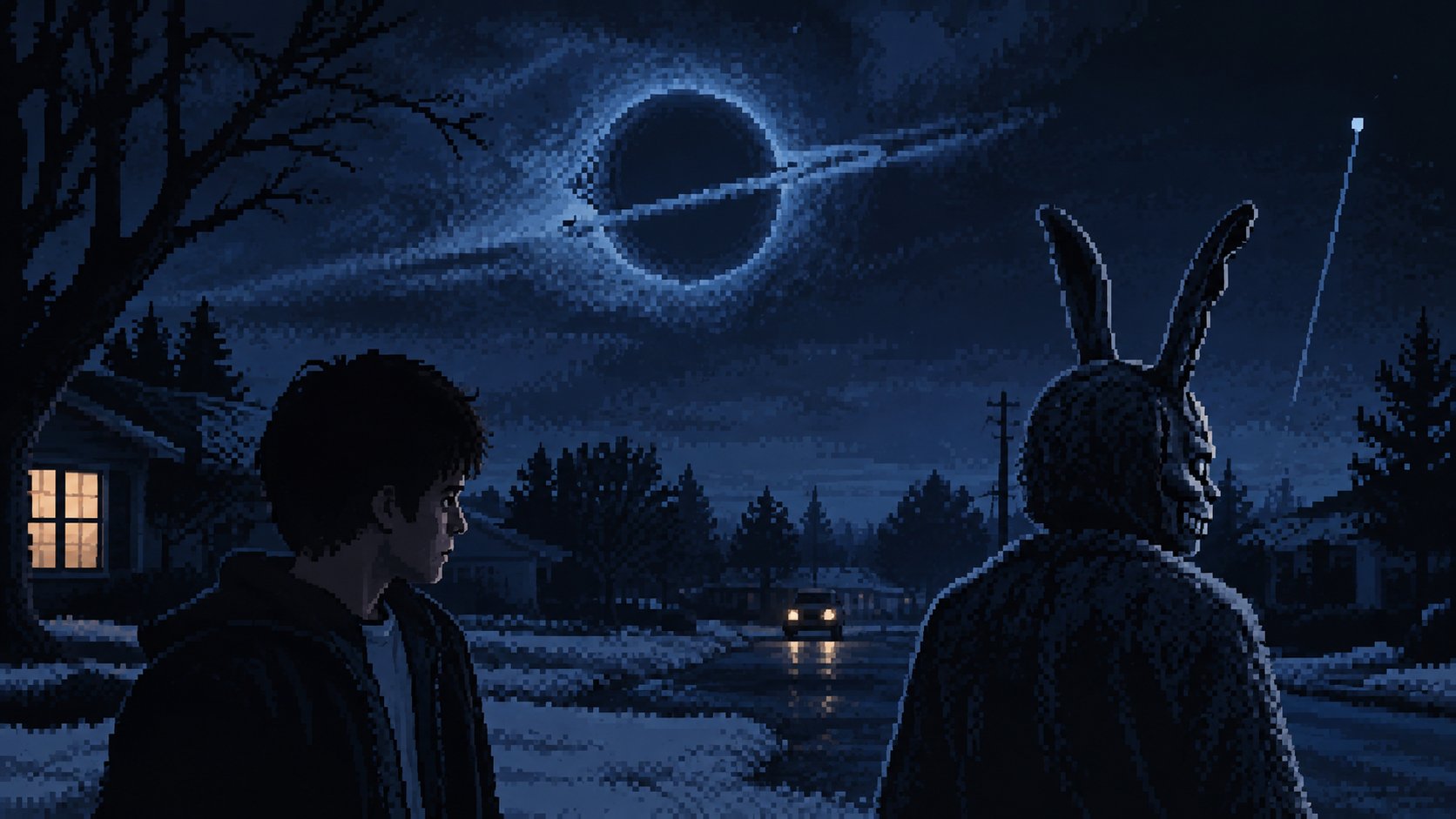
Pixel art inspired by “Donnie Darko” (2001)
The Donnie Darko ending explained simply: Donnie lets the jet engine fall on him, closing the broken “tangent universe” and saving the people he loves. He laughs because his deepest fear, dying alone and for nothing, turns out to be false. His death is chosen, it has a meaning, and it ties him to others instead of cutting him off from them.
I want to separate the mechanics of the plot (the engine, the loop, the rules of the book) from the meaning of the film, check both against the film’s own rules and against what Richard Kelly, who wrote and directed the film, has said about the force guiding Donnie, and bring the whole thing down to one idea. Kelly built a clockwork machine so that a teenage boy could make one decision, and that decision is the film. I read it as a stoic film: accept what you cannot change, act on what you can, and the boy in the bed learns to do both.
Donnie Darko ending explained: what happens at the end?
Time rewinds to the night of October 2, 1988, the jet engine crashes through the roof again, and this time Donnie stays in bed. He dies, the tangent universe collapses, and everyone he saved wakes up in a world where the last 28 days never happened.
At the start, a figure in a rabbit suit lures our sleepwalking hero out of the house just before a jet engine falls into his bedroom. Everything that follows happens in a world that should not exist, because the boy was supposed to die in that bed. By the final night, that world has gone wrong in every direction. The girl he loves lies dead on the road. He has shot the young man who killed her. His mother and little sister are on a plane about to tear apart in the sky. He sends the engine back, the film rewinds, and we see him in his bed, awake, waiting.
Why does Donnie laugh before he dies?
This is the moment I care about most. One common reading, which Looper sets out, is that he laughs because he has carried out the plan: he has saved the universe and, with it, Gretchen and Frank.[1] Kelly’s own commentary frames the force guiding him as something close to God, fate or destiny.[1] I do not read it as “it was all a dream” or “he was crazy all along.” He remembers, or understands at some level below memory, what the other version of events cost. If he runs from the engine again, the girl dies, the young man in the rabbit suit dies, his mother and sister are put in mortal danger, and the whole world may stop existing. So he stays.
He laughs out of relief and out of the sheer paradox of it. For the entire film this boy has been terrified of dying alone. Now he chooses to die alone, in his own bed, and that exact death is what connects him to everyone else and saves them. It is a moment of enlightenment: for the first time, he knows precisely what to do.
So who dies? In the final, “real” timeline, only Donnie. Every other death happened in a world that has been erased.
What is the tangent universe, and what caused it?
The tangent universe is an unstable copy of reality that splits off when the engine appears without a cause. It can only last 28 days, and if it is not closed it collapses and takes the primary universe with it.
Inside the fiction, the rules come from a book called The Philosophy of Time Travel, written by the old woman the town calls Grandma Death. The book (excerpts of which Kelly added to the director’s cut)[2] gives us the vocabulary: the Primary Universe, the Tangent Universe, an “Artifact” that appears in it (the engine), and a “Living Receiver” chosen to send that Artifact back before the tangent collapses. Around him, the “Manipulated Living” and the “Manipulated Dead” quietly push him toward his task.
What caused it? The film never gives a tidy origin, and I think that is deliberate. Dramatically, the tangent universe is a world that exists because Donnie escaped his death. In a sense, his survival is the tangent universe: every day he lives past October 2 is borrowed time.
Where did the jet engine come from?
The engine comes from the future. It falls off the airliner carrying Donnie’s mother and sister home from Los Angeles on the last night of the tangent universe, and Donnie sends it back through the vortex so it lands in his bedroom 28 days earlier.
The engine that nearly kills him at the start is the one that comes loose at the end. Nobody can find which plane it belongs to, because the plane has not lost it yet. On the ridge, Donnie is the “Living Receiver” closing the circuit: the engine goes back, the tangent universe closes, and the only cost is the life he should never have kept. As a storyteller I love that Kelly takes the biggest possible event and aims it at the smallest possible room: a teenager’s bed.
Who is Frank, and why is Frank a bunny?
Frank is the young man in the rabbit costume, the boyfriend of Donnie’s older sister, who later runs over the girl Donnie loves and is shot by him. The Frank who visits Donnie is a version of that young man after his death, a messenger returning from the future to steer the past.
He is, at the same time:
- a messenger of death,
- the boy’s guide through the 28 days,
- the man the boy will kill,
- and a consequence from the future that comes back to change its own past.
The simplest way I can put it: Frank is death, who first saves Donnie so that Donnie can understand why he should die. Notice the wound. The visitor in the mask has a ruined eye. On the last night, the young man in the costume takes off his mask, and the boy shoots him through that eye. The ghost carries the injury before it happens.
And the rabbit? Watership Down by Richard Adams is a clear thematic companion to the character, and the book is woven into the film (in the director’s cut the English teacher assigns it in place of the Graham Greene story and the class discusses it[3]; it is the novel of Fiver, the small rabbit whose apocalyptic visions save his warren). It is a story about a community under threat, about sacrifice, and about the search for a safe place. The rabbit is not a random horror mask. It is the film’s theme wearing a costume.
Is Donnie schizophrenic, or is the time travel real?
The film’s own rules suggest that the science fiction is real inside its world, which resists the reading that everything is just Donnie’s schizophrenia. But the film is built so that both readings stay available, and that ambiguity is part of the point.
Donnie sees a therapist, takes medication, and hallucinates a six-foot rabbit, so you can watch the whole film as a portrait of illness. The film pushes back: its science fiction world has real rules. Here is what matters to me. The tangent universe, the engine and Frank are neither only metaphors nor only gadgets. The fantastic construction exists so that the boy can see the consequences of his continued life and then make the decision again. The sci-fi machinery gives a physical form to his inner question: is it better to survive and cause other people’s suffering, or to die so that others can live?
Destiny or free will: what is the point of Donnie Darko?
The film never fully settles it. Donnie is guided, almost pushed, by Frank and by the people around him, but he performs the one act that matters himself: this time, he does not leave the room.
You can read him as a tool of destiny. The rabbit leads him step by step, and the people around him are placed like pieces on a board. And yet the decisive action is his. This is where the apparent opposites make peace: we do not choose all the circumstances of our lives, but we can choose how we answer them. He does not choose the falling engine. He chooses to stay underneath it.
For me, this is the most important thing in the film, and it is why I think of Donnie Darko as a deeply stoic film. Stoicism is not indifference to your fate. It means responding with dignity to the things you can influence and changing them according to your ethics, and on the other side, accepting what you cannot change, whatever fate hands you. The boy does both. He accepts the engine. And he acts on what he can change: his own survival, which is what leads to all the other tragedies.
Love or fear: why does the “Lifeline” lesson matter?
The gym teacher makes her students sort every human action into two boxes: love or fear. He rebels, because life is far more complicated than that. The film deliberately shows this system as a crude reduction of reality.
The ending, though, turns back to that split in a sly way. At the start, the boy acts mostly out of fear: of loneliness, of death, of meaninglessness, of losing control. At the end, he performs an act of love. So the gym teacher is right on the most basic level, and completely wrong about the price. Love is not a slogan from a self-help video. It can mean consciously accepting suffering and death.
Why does Gretchen wave at the end?
Because something of the erased world survives in the people who lived through it. Gretchen does not remember Donnie, yet she waves to his grieving mother as if she knows her, and the mother waves back.
Set to “Mad World”, the final montage shows the town waking after the rewind. Nobody consciously remembers the 28 days, but something stays. The young man who wore the rabbit suit touches his eye. The motivational speaker wakes up weeping. Others wake with guilt, sadness, unease. And the girl the boy loved, riding past the house the morning after his death, waves to a woman she has never met.
My reading: our bonds, and the moral consequences of what we do, live deeper than conscious memory. Donnie dies physically alone, yet the people he saved carry a trace of his sacrifice inside them. That wave is the proof that he was right to stop being afraid.
Why was the teacher fired, and what is the film’s second layer?
The English teacher is fired after the gym teacher, a devotee of the self-help guru, blames the school’s flooding on Graham Greene’s story “The Destructors”, which she had assigned, and rallies the parents against her. Her firing belongs to the film’s second layer: a smart teenager seeing through the falseness of the adult world.
It is also a film about a gifted kid among adults who cannot answer the real questions:
- the school replaces thinking with slogans,
- the authorities turn out to be hypocrites (the man selling love and fear is hiding something monstrous in his house),
- the adults have no answers to the questions that actually matter,
- and society labels the inconvenient boy as sick, even though he sees its dishonesty more clearly than anyone.
Donnie confronts a system of conformity while trying to understand his community. Underneath is a timeless conflict between generations: the young face problems their elders do not understand.
What is Donnie Darko really about?
It is about making peace with death by discovering that we are bound to other people.
Donnie “saves the world”, yes, but that is the surface. At the beginning he is afraid he will die alone. At the end he understands that a person may die alone, but does not have to die without love, without meaning, without connection to others. That is why he laughs. He has found out that his greatest fear was false. It is the stoic lesson I mentioned at the start, lived rather than preached: he cannot change the engine, so he accepts it, and he can change what his survival does to others, so he acts.
Still, there is no single, mathematically closed answer here. The viewer’s disorientation and the open questions feel intended, and the film reveals new layers on repeat viewings. The uncertainty is part of the meaning: like the boy in the bed, we are never handed a complete instruction manual, and still we have to decide what we will give meaning to.
So if I had to say what the film is about in a single breath, here is my reading. For me this is, at its core, a stoic film, and the governing idea it steers by is this:
Life is a chaos no one controls, and what remains ours is the response: to meet what we cannot change with dignity, and to build our lives around the good of others instead of around our own fear.
Nobody in the film ever says this out loud. It is carried by the rabbit, the countdown, the wound in Frank’s eye, the waving hand on the morning after, and above all by the arc of a boy who goes from running away from the engine to waiting for it.
And if I imagine the short line Kelly might have kept in his head on set, the beacon that keeps every scene, every song and every cut pointing at that bed, my guess is it would be this:
You do not choose your fate, only how you meet it.
How Richard Kelly makes you feel it before you understand it
What strikes me most, as a filmmaker, is the delivery. The philosophical core is hidden and, at its depth, very simple, and Kelly tells it as a coming-of-age movie. I do not know another film that joins coming-of-age and science fiction this well, stays this philosophically rich, and keeps its science fiction from ever feeling silly. That balance is why people still argue about it twenty-five years later.
The trick is that the film works emotionally before it works logically. Kelly hides a rigid sci-fi mechanism under a teen-movie surface, so you follow the boy, the girl and the school, and only later realize every scene was a gear in a clock.
A few of his tools:
- Needle-drops. The 1980s songs make the town feel lived-in and ordinary, so the impossible things land harder against them.
- The slow-motion Steadicam through the school. The gliding introduction to the corridors, cut to a pop song, presents the whole social world in one breath. It feels like a music video, and that is the point: it is the teen-movie surface, and it seduces us before the machine starts turning.
- A score that carries the dread. Under the jokes, the music keeps a low, melancholy pulse, so you feel the countdown in your body even in trivial scenes.
- The countdown as structure. Title cards counting down the days turn a loose teenage story into a clock. Give the audience a deadline and every ordinary scene gains tension.
- Restraint with the fantastic. The rabbit, the water “spears” and the vortex are staged plainly and never over-explained, so they read as part of this world rather than as effects.
The final rewind is the clearest example: the film reverses its whole plot and gives us not an explanation but a face, a boy in bed, laughing.
If you want to learn to hide a meaning inside structure so the audience feels it long before they can explain it, that is exactly what I teach in Understanding Films: Decode the Invisible Meaning.
Quick answers
What is the song at the end of Donnie Darko?
It is “Mad World”, the Tears for Fears song, in a slow cover by Gary Jules with Michael Andrews.[4] It plays over the final montage of the town waking up.
Should I watch the theatrical cut or the director’s cut?
Watch the theatrical cut first; it keeps more mystery. The director’s cut puts pages of The Philosophy of Time Travel on screen and spells out the rules, which is great on a rewatch but explains too much the first time.
Who plays Frank in Donnie Darko?
Frank is played by James Duval.[4] The rabbit suit is his Halloween costume.
Is there a Donnie Darko 2?
There is a sequel, S. Darko (2009), following Donnie’s younger sister, but Richard Kelly was not involved in it.[5]
Sources
- Donnie Darko’s Ending Explained — Looper ↩
- How Donnie Darko: The Director’s Cut Changes The Movie — /Film ↩
- What’s the Difference Between the Donnie Darko Theatrical and Director’s Cut? — SYFY WIRE ↩
- Donnie Darko (2001) Full Cast & Crew — IMDb ↩
- ‘Donnie Darko’ director says 2009 sequel was “horribly violating” — NME ↩