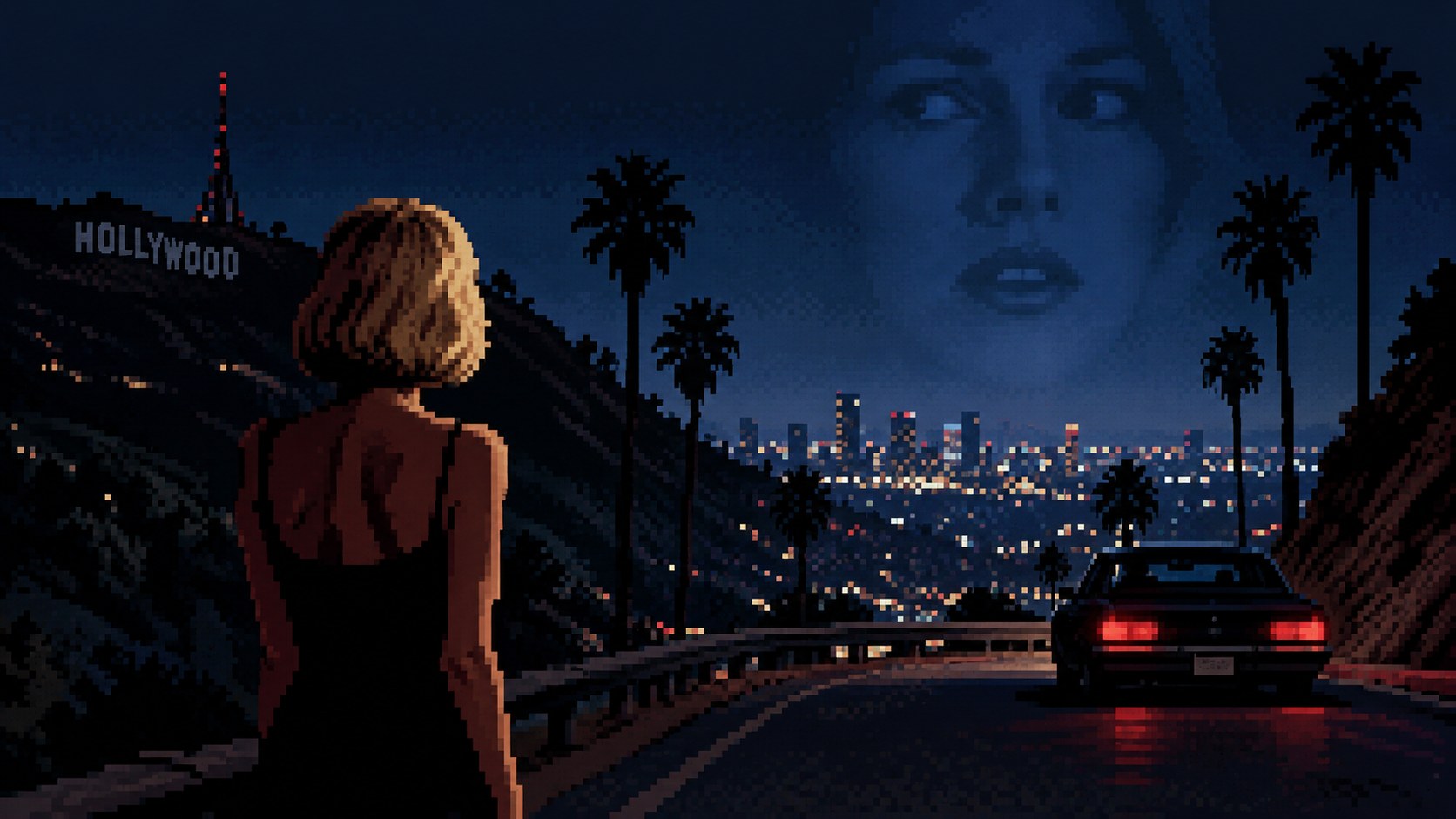
Pixel art inspired by “Mulholland Drive” (2001)
Mulholland Drive is mostly a dream. In her final hours, a failed Hollywood actress reimagines her own life as a hopeful success story, editing out the rejection and the murder she arranged, and the last stretch of the film shows us what really happened. You do not need a decoder ring: one scene, the engagement party at a director’s house on Mulholland Drive, explains the whole film.
People treat this film as a puzzle box, with lists of clues and charts of every character. I think that misses how simply David Lynch built it. Here is my reading.
What is Mulholland Drive about, explained simply?
Mulholland Drive is about a woman who could not bear the truth of her own life, so her mind wrote a better version of it. For the first two hours we follow a bright, eager newcomer arriving in Los Angeles, full of hope, who helps a beautiful amnesiac she quickly falls for. That whole sunny story is a dream. The final stretch, after the blue box opens, is the reality underneath it: our heroine is a failed actress, rejected by the woman she loved, who paid to have her killed and cannot survive the guilt.
The structure reminds me of Slaughterhouse-Five, Kurt Vonnegut’s 1969 novel. Its hero, Billy Pilgrim, comes unstuck in time and tells us he was kidnapped by aliens from the planet Tralfamadore and kept in their zoo beside a beautiful movie actress. For most of the book we take this fantastic reality as given. Then, late in the novel, comes a single scene in a seedy bookstore in Times Square. Billy finds a cheap science-fiction paperback by his favourite writer, Kilgore Trout, about two Earthlings kidnapped and put on display in an alien zoo, and in the same shop a film is playing that stars the very actress who, he says, shared his cage.[1] Vonnegut never spells it out, but the hint is hard to miss: Billy’s aliens may well have come off those cheap pages. The fantastic material is the mind’s way of telling an unbearable true story from a safe distance. Mulholland Drive works the same way. The dream is sincere, detailed, and full of feeling, and none of it happened.
The dream is not a lie Lynch tells us. It is a lie the heroine tells herself, and the film lets us believe it with her until it can no longer hold.
Which scene explains Mulholland Drive?
The dinner party at the director’s house on Mulholland Drive explains everything. Start from this scene when you rewatch, and the film reorganizes itself. Our heroine arrives at the party in a borrowed role, brought along as a guest, not as a partner. She sits at the table and tells the story of how she came to Hollywood, won a jitterbug contest, and hoped to become a star. She watches the woman she loves lean into the director. She watches that same woman turn and kiss a blonde guest, almost casually, as if our heroine were not in the room. And she sits through the build-up to an engagement announcement that is, for her, a public execution.
It helps to know how she got there. The woman she loves invited her. When the car stops in the dark on Mulholland Drive, she is the one who steps out of the trees, takes our heroine by the hand, and leads her up a hidden path to the house. And nobody at that table knows the two women were lovers. To everyone else it is a warm, happy evening, a celebration of the director and his future wife. Only the two of them know what it really is, and the woman she loves uses that secret to hurt her in front of everyone, where she cannot even react.
Now look back at the dream, and watch it recycle that evening. The blonde woman kissed at the party reappears in the dream as a rival actress, the one a conspiracy forces on the director. The dark-haired woman she loved comes back stripped of her name and her memory, helpless and dependent on our heroine, exactly the version who could never leave her. The director becomes a man whose life falls apart in a single afternoon. Faces that only passed through the room that night are recast as gangsters, messengers, and fixers.
The dream is a collage of that one evening, kinder where she needs comfort and crueller where she needs revenge.
Who is Diane Selwyn, and are Betty and Diane the same person?
Yes, they are the same woman, both played by Naomi Watts. Here are the two names, so you can stop tracking them: in reality she is Diane Selwyn, the failed actress, and in the dream she recasts herself as Betty, the hopeful newcomer. Betty is who she wished she were: talented, innocent, welcomed, adored. Diane is who she actually became: broke, haggard, and abandoned by the woman she loved. From here on I will just call her our heroine.
The dream even hides her real fate inside itself. Playing detective, the dreaming heroine and the amnesiac follow a name to an apartment and find a decomposing body on the bed. That dead woman is the heroine herself. Her sleeping mind cannot quite keep the truth out, so it slips her own corpse into the story as a mystery for someone else to solve.
Why does the whole world conspire against Betty?
This is the theme I most want you to see, because I think it is the emotional heart of the film. In the dream, our heroine is a great talent, and the whole world has organized itself to stop her.
Look at what the dream builds around her:
- A hitman hunting a black book of names and numbers, who will kill people just to get it. He belongs to the dream’s picture of Hollywood as a corrupt machine: money, connections, and violence hidden under the glamour, working against her no matter how talented she is.
- A cabal of money men, two sinister brothers and a strange, nearly immobile figure sealed in his room, forcing the director to cast a different woman. Their cold refrain, “This is the girl”, repeats until it sounds like a verdict.
- The one decent exception, the director himself, who looks up the instant he sees her at the audition and is visibly struck, before he is forced to look away and say the line he was ordered to say.
Read her self-portrait straight off that: I was brilliant, the system was rigged against me, and the right man would have chosen me instantly if the machine had let him. She sorts everyone into the worthy and the unworthy. People who wounded her become villains or fools. People who could have saved her become victims of the same conspiracy.
And here we reach the heart of it: for all her great talent, the world she builds around herself, the Hollywood world, is heartless and merciless.
That is heartbreak rewriting failure as persecution.
Who is the Cowboy in Mulholland Drive?
The Cowboy is not a mystical figure, and I think the usual explainers badly over-read him. In my reading he is a minor guest at the party, a man in a hat who walked through the room. Our heroine’s sleeping mind grabs him like a prop and inflates him into an agent of the conspiracy.
The same goes for the fussy man who tastes the espresso, finds it unacceptable, and spits it into a napkin. He is a diner, not a deity. Dreams speak in borrowed images. Your mind does not invent a stranger from nothing; it takes a face you half noticed and gives it a job.
So the Cowboy gets the job of delivering the conspiracy’s threat to the director, in calm, folksy, sinister sentences about attitude and the man driving the buggy. It is an unforgettable scene, and its power comes from the fact that someone so ordinary speaks with such total authority. That is what dream logic feels like.
Don’t try to “solve” each strange figure. Guilt and jealousy are doing the casting, and the strangeness is the texture of a dream, not a code. The same applies to the man behind Winkie’s diner, the figure people search for as “the monster” or “the hobo”. He is the dream’s embodiment of the dread waiting at the back of the diner where our heroine did the worst thing she ever did.
As the dream runs on, it stops protecting her. The fantasy curdles into nightmare and falls apart, because no story this flattering survives contact with what she did.
What is the blue box in Mulholland Drive?
The blue box is the seam between the dream and reality. When it is opened with the blue key, the dream collapses into it, and the film wakes up inside the heroine’s real life. There is nothing “in” the box: it is a door, not a container.
Notice where it comes from. The box turns up in the heroine’s purse after the night at Club Silencio, the night the dream itself announced that everything was an illusion. Her dream self vanishes. The dark-haired woman opens the box. The camera falls into the darkness inside it, and the next person we see is our heroine, awake in her real life.
There are two blue keys, and keeping them apart clears up most of the confusion:
- The ornate dream key opens the box. It is the key to reality, which is why opening the box ends the dream.
- The plain, ordinary blue key on the heroine’s coffee table is the real one. At the diner, the hitman told her that when the job was done she would find a blue key. It is his signal that the woman she loved is dead.
The dream turned a cheap key, a sign of murder, into a beautiful object at the center of a mystery. That is exactly what this mind does with everything.
Mulholland Drive ending explained: what happens to Diane?
In the last stretch of the film we see our heroine as she really is: broke, worn out, mourning a woman she had killed. Fragments show the affair, the rejection, the party, and the meeting at the diner where she hired the hitman. The blue key confirms the job is done, and the guilt becomes more than she can carry.
These scenes are not chronological, and they are not meant to be. They arrive the way memory and shame arrive, out of order and all at once.
Then the elderly couple returns. In the dream they were the kindly strangers who wished her well when she first flew into Los Angeles, full of hope. Now they come back shrunk to the size of mice, scuttling in under her door, then grown again and laughing, pursuing her through the apartment. The people who once stood for her innocent hope become the faces of her shame. She runs to the bedroom and shoots herself.
The final word belongs to a woman in the balcony of Club Silencio: “Silencio.” The performance is over.
What does Silencio mean?
“Silencio” means silence, and Club Silencio is the place where the dream tells you, out loud, that it is a dream. The host insists there is no band, that it is all a recording, that it is an illusion. Then a singer performs a heartbreaking song in Spanish, collapses, and her recorded voice keeps singing without her.
Our heroine and the woman she loves weep in the audience. That detail matters to me more than any clue. They are moved by a performance they have just been told is fake, and the feeling is real anyway. That is the film’s thesis in one scene: everything here is a performance, and the emotion is real even when the thing producing it is not. Right after, the blue box appears. The dream has confessed, and it cannot continue.
We have traced the whole dream back to a single party and watched it come apart. So what is Mulholland Drive, underneath all of it, really about? Now that we have followed the symbols, we can name the one idea the film steers by, the lighthouse Lynch set for himself. For me, Mulholland Drive is about the deconstruction of fantasy.
Mulholland Drive is about the deconstruction of fantasy. It builds a seductive, consoling dream in front of you, then forces it to meet reality, and shows that no illusion, however beautiful or badly needed, can survive the collision. Hollywood, the great factory of fantasy, is the perfect place to stage that reckoning.
No illusion survives its collision with reality.
The craft layer: how Lynch makes you feel the lie
Lynch liked to give the impression that his images simply arrived, pure intuition with no labour behind them. People who knew him early tell a different story. Someone who studied alongside him at film school once told me, privately, that he worked and reworked his scripts obsessively, and that what looks like free association was built with enormous care. I believe it, because I write and teach this craft myself. Precision like this is not luck.
The production history supports that view. Mulholland Drive began as a television pilot for ABC, which the network rejected.[2] French producers at StudioCanal then financed turning it into a feature with a proper, closed ending, and Lynch shot new material to complete it.[3] The ending seems to have come to him late, almost in a flash of inspiration. My own reading, and I offer it as an opinion, not a fact: he had this destination in mind all along, and the “sudden” new scenes were a tight synthesis of ideas he was already holding. I have also read that the new material came to a relatively small number of pages, though I am not certain of the figure, so I will not quote one.
Watch the craft instead of the plot, and you see the control everywhere in the dream:
- Sound. Under the “happy” scenes runs a low hum, a pressure you feel before you can name it. The newcomer’s arrival is bright, but the soundtrack never fully agrees with the image. Your body knows something is wrong before your mind does.
- Light. The dream self is lit like an advertisement: smooth, warm, flattering, a Hollywood dream of a Hollywood dream. The real woman lives in a sickly, underexposed world of stale browns and greys. Light separates the two halves of the film as clearly as plot does.
- Cutting. Lynch holds a shot half a beat too long on a smile, the old couple grinning in the back of their car, and the smile curdles. Nothing in the dialogue is threatening. The duration does the work.
- Performance. Naomi Watts plays the hopeful dream self with a deliberate, slightly too-perfect sweetness, then plays the real woman with no protection at all. The difference between the two performances is the difference between the dream and the truth, and it is all on her face.
At Club Silencio, Lynch states the whole method out loud: there is no band, it is all a recording, and the feeling is real anyway. That is what directors do with light, sound, and time. The dialogue says one thing, the image says another, and the second voice is the one you believe.
Learning to read that second layer, the one the camera, the light, and the sound speak underneath the words, is exactly what I teach, and if this way of watching films excites you, it is a skill you can learn.
If you want to learn to spot the choices a director makes that you feel but never notice, that is exactly what I teach in Understanding Films: Decode the Invisible Meaning.
Quick answers
Does Mulholland Drive make sense?
Yes, more than its reputation suggests. Read the first two hours as a dream and the last stretch as reality, and nearly every strange detail finds a source in the heroine’s real life, especially in the party at the director’s house.
Did David Lynch ever explain Mulholland Drive?
No. He offered a short list of ten cryptic “clues” with the DVD release[4] and left the final step to the viewer. He never confirmed any single interpretation, including this one.
What does the blue key mean?
There are two. The ornate key in the dream opens the blue box, the door back to reality. The plain blue key in the heroine’s apartment is the hitman’s signal that the woman she loved is dead.
Who are the old people in Mulholland Drive?
They are the friendly couple the heroine meets on her way to Los Angeles, a picture of the hope she once carried. At the end they return as tiny, laughing figures who drive her to suicide: hope turned into guilt.
What happened to the woman she loved?
In reality, our heroine paid a hitman to kill her after she left her for the director. In the dream, she survives as the amnesiac who needs our heroine, which is exactly the version the heroine wished she had.
Sources
- Kurt Vonnegut, Slaughterhouse-Five (1969), chapter 9. See: Slaughterhouse-Five, Chapter 9 summary, LitCharts ↩
- The Definitives: Mulholland Dr. — Deep Focus Review ↩
- Mulholland Drive, review — Variety (2001) ↩
- The One Time David Lynch Gave Us Clues To Unlock His Work — SlashFilm ↩